10 Best Solar Panels for Portable Power Stations (October 2026)
The best solar panels for portable power stations include the Renogy 200W Portable Solar Panel for weekend camping, the Jackery SolarSaga 200W for Jackery owners, and the EcoFlow 220W Bifacial Solar Panel for faster solar input.
On this page (18 sections)
- Best Solar Panels for Portable Power Stations
- How to choose the best solar panels for a portable power station
- Compare the best solar panels for portable power stations
- 1. Renogy 200W Portable Solar Panel: Best for weekend camping
- 2. Jackery SolarSaga 200W: Best for Jackery station pairing
- 3. EcoFlow 220W Bifacial Solar Panel: Best for higher rated panel output
- 4. Bluetti PV200 Solar Panel: Best for Bluetti station owners
- 5. Renogy 100W Portable Solar Panel: Best for lighter solar setups
- 6. ZOUPW 200W Portable Solar Panel: Best for a wide adapter selection
- 7. ZOUPW 100W Portable Solar Panel: Best for 100W multi-connector charging
- 8. HQST 200W Portable Solar Panel: Best for a lighter 200W panel
- 9. Jackery SolarSaga 100W Air: Best for a small packed size
- 10. EBL 200W Portable Solar Panel: Best for a basic 4-in-1 cable kit
- How do you set up and care for a portable solar panel?
- What common solar panel buying mistakes should you avoid?
- Is a 100W or 200W solar panel better?
- Do bifacial solar panels help with a power station?
- What is the best solar panel for a portable power station?
Best Solar Panels for Portable Power Stations
The Renogy 200W Portable Solar Panel is the top pick among the best solar panels for portable power stations for buyers who want a folding 200W panel with USB charging. Choose a 100W model to carry less weight, or match a brand-specific panel to a station you already own.
A useful panel match depends on its rated power, voltage and connector, plus the station’s solar input limits. Rated wattage is a guide under suitable conditions, and shade, clouds, angle and heat affect the power you receive.
If you’re still comparing stations, start with our plain guide to portable power stations. For the difference between a power station and a solar generator, see portable power station vs solar generator.
Our picks at a glance
-
1

-
2

-
3

- 4
 Best for Bluetti pairingCheck it
- 5
 Check it
Renogy 100W Portable Solar Panel
Best for light packing - 6
 Check it
ZOUPW 200W Portable Solar Panel
Best for adapter flexibility - 7
 Check it
ZOUPW 100W Portable Solar Panel
Best for small stations - 8
 Check it
HQST 200W Portable Solar Panel
Best for lighter 200W carry - 9
 Best for compact storageCheck it
- 10
 Best for bundled adaptersCheck it
How to choose the best solar panels for a portable power station
Choose a panel by checking electrical compatibility first, then weigh wattage, weight, cable options and setup features against how you’ll use it. A convenient fold and a high efficiency claim don’t help if the station can’t accept the panel’s voltage or connector.
Start with the power station manual. Find its maximum solar input, supported voltage and current, and connector type, then compare those limits with the panel and any adapter you plan to use.
A panel’s rated wattage is not a promise of the power you’ll see in the field. Direct sun, panel angle and clear exposure improve output, while clouds, shade and the station’s input ceiling can reduce or cap it.
Consider how far you’ll carry the panel. The 7 lb Jackery SolarSaga 100W Air is easier to move than the 18.96 lb ZOUPW 200W, while the heavier panel has twice the rated output.
Cable convenience matters too. ZOUPW includes five connector types on its 100W and 200W models; Renogy’s 100W and 200W panels use MC4 output and sell the 4-in-1 adapter separately.
Our scores weigh each panel’s specs, connection options and outdoor setup features against the needs of a portable power station buyer. Confirm the exact station model before ordering, because broad compatibility claims do not replace checking voltage, current and input limits.
Compare the best solar panels for portable power stations
The table below highlights rated output, carry weight and connections across the best solar panels for portable power stations. Use it to shortlist a panel, then confirm that your station accepts its electrical output.
| Product | Best for | Rated power | Weight | Output | Our score |
|---|---|---|---|---|---|
| Renogy 200W Portable Solar Panel | weekend camping | 200W | 13.89 lb | MC4, USB-C, USB-A | 8.6 |
| Jackery SolarSaga 200W | Jackery owners | 200W | 14.3 lb | USB-A, USB-C, DC8020 | 8.5 |
| EcoFlow 220W Bifacial Solar Panel | faster solar input | 220W | 15.4 lb | MC4 | 8.3 |
| Bluetti PV200 Solar Panel | Bluetti pairing | 200W | 17.2 lb | Solar connector | 8.2 |
| Renogy 100W Portable Solar Panel | light packing | 100W | 8.86 lb | MC4, USB-C, USB-A | 8.1 |
| ZOUPW 200W Portable Solar Panel | adapter flexibility | 200W | 18.96 lb | XT60, Anderson, DC7909, DC8020, DC5521, USB | 8.0 |
| ZOUPW 100W Portable Solar Panel | small stations | 100W | 9.48 lb | XT60, Anderson, DC7909, DC8020, DC5521, USB | 7.9 |
| HQST 200W Portable Solar Panel | lighter 200W carry | 200W | 11.82 lb stated in product highlight | XT60, DC7909, DC5521 | 7.8 |
| Jackery SolarSaga 100W Air | compact storage | 100W | 7 lb | Multifunctional solar charging cable, USB ports | 7.6 |
| EBL 200W Portable Solar Panel | bundled adapters | 200W | 17.95 lb | MC4 with XT60, Anderson, DC7909 and aviation connectors | 7.4 |
1. Renogy 200W Portable Solar Panel: Best for weekend camping
Renogy 200W Portable Solar Panel: Best for weekend camping
- 200W output
- 25% efficiency
- 13.89 lb
- USB-C PD 45W and 2 USB-A ports
A folding 200W option with a magnetic closure and direct USB charging. Its MC4 output means you need a compatible cable or adapter for your power station.
Pros
- 25% efficiency
- USB charging ports
- Magnetic closure
Cons
- 4-in-1 adapter sold separately
- Station compatibility depends on its input requirements
Renogy combines a 200W rating with a folded size of 23.72 x 22.99 x 1.97 in and a magnetic closure. At 13.89 lb, it has a compact folded profile for car trips, campsites and backup use.
Four kickstands offer 40, 50 or 60 degree positions. USB-C PD rated up to 45W and two USB-A ports allow direct device charging.
The station connection needs planning. This panel has MC4 output, and Renogy’s 4-in-1 adapter is sold separately, so check whether your station accepts MC4 directly or needs a compatible cable.
Renogy names compatibility with the Jackery Explorer 1000 v2, EcoFlow DELTA 3 and RIVER 3 Max, Anker SOLIX S2000, and other models that meet its requirements. Choose it for a portable 200W panel with a small folded profile and useful direct USB charging.
2. Jackery SolarSaga 200W: Best for Jackery station pairing
Jackery SolarSaga 200W: Best for Jackery owners
- 200W rating
- 26.7% efficiency claim
- 14.3 lb
- Bifacial design
The bifacial panel has USB ports and a DC8020 connection, with compatibility named for several Jackery Explorer stations. Confirm the exact model and input limits.
Pros
- Bifacial design
- USB-A, USB-C and DC8020 ports
- IP68 rating
Cons
- Cable ports are not weatherproof
- Named compatibility centers on Jackery stations
The SolarSaga 200W is a bifacial panel with USB-A, USB-C and DC8020 connections. Jackery names compatibility with several Explorer stations, including the 1000 Plus, 2000 Pro, 2000 Plus and 3000 Pro.
Its stated efficiency is up to 26.7%, and the panel weighs 14.3 lb. The bifacial design is intended to collect light from both sides, though the light reaching the back depends on placement and surroundings.
The included charging cable has multiple connectors, but Jackery notes the cable is not weatherproof. Keep the cable connection dry even though the panel itself has an IP68 rating.
Choose it if you own a compatible Jackery station and want that brand’s named pairing. Skip it if you need a panel with broad cross-brand adapter options in the box, and check the exact model’s input limits before buying.
3. EcoFlow 220W Bifacial Solar Panel: Best for higher rated panel output
EcoFlow 220W Bifacial Solar Panel: Best for faster solar input
- 220W rating
- 25% efficiency claim
- 15.4 lb
- 30–60 degree adjustable bracket
This 220W bifacial panel adds an adjustable bracket and IP68 rating. Match its MC4 connection and electrical limits to the station before buying.
Pros
- 220W rating
- Adjustable bracket
- IP68 rating
Cons
- Heavier than several 200W picks
- MC4 connection may need an adapter
EcoFlow’s panel has the highest rated wattage in this group at 220W. It weighs 15.4 lb and uses a bifacial design, N-type cells and an adjustable bracket with a 30 to 60 degree range.
The bracket and solar angle guide help you position the panel toward the sun. EcoFlow states an efficiency of up to 25% and an IP68 rating for water and dust protection.
Its output connection is MC4. Before pairing it with a station, check that the station accepts the panel’s voltage and that any needed cable or adapter suits the model.
Pick it when the extra 20W of rated output over a 200W panel fits your station’s solar input range. Skip it if low carry weight is the main goal; a 100W panel is lighter.
For charging time factors, read our guide to how long a portable power station takes to charge.
4. Bluetti PV200 Solar Panel: Best for Bluetti station owners
Bluetti PV200 Solar Panel: Best for Bluetti pairing
- 200W rating
- Up to 23.4% efficiency
- 17.2 lb
- Foldable design
Bluetti names a wide range of its power stations as compatible, and the panel uses a solar connector. Check voltage compatibility, especially if pairing it with another brand.
Pros
- Broad named Bluetti compatibility
- Foldable
- ETFE coating
Cons
- Heavier than some 200W choices
- Confirm voltage and connector fit
The Bluetti PV200 is a foldable 200W panel with a solar connector and stated efficiency up to 23.4%. It weighs 17.2 lb and folds to 22.5 x 23.6 x 2.9 in.
Bluetti names compatibility with a range of its stations, including the EB3A, AC70, AC180, AC200L, AC300 and AC500. The brand advises checking the panel’s voltage against the station’s requirements.
That voltage check matters even when a connector fits. If you use a station from another brand, confirm its supported solar input rather than relying on a general compatibility claim.
Choose the PV200 for a Bluetti-to-Bluetti pairing, especially when the models are among those named by the brand. Skip it if weight is a deciding factor, since several picks here are lighter.
5. Renogy 100W Portable Solar Panel: Best for lighter solar setups
Renogy 100W Portable Solar Panel: Best for light packing
- 100W rating
- 25% efficiency claim
- 8.86 lb
- USB-C PD 45W and 2 USB-A ports
The 100W size is easier to carry than a 200W panel and includes direct USB charging. Its MC4 output requires a compatible station connection.
Pros
- Lighter than the 200W panels here
- 25% efficiency claim
- USB charging ports
Cons
- Lower rated output
- 4-in-1 adapter sold separately
This Renogy panel weighs 8.86 lb and folds to 22.99 x 22.54 x 1.57 in. Its 100W rating gives you a lighter panel to carry, though it has a lower rated output than a 200W panel.
It has USB-C PD up to 45W and two USB-A ports for charging small devices. The station output uses MC4, and Renogy sells its 4-in-1 adapter separately.
Renogy names compatible models from Jackery, EcoFlow, Anker, Bluetti and other brands, provided their voltage, current and connector needs match. Renogy says parallel wiring helps limit the effect of individual shadows on interconnected panels.
Choose it for a compact 100W option when your station and charging needs suit that output. Skip it if you need the highest possible panel rating from one foldable unit.
6. ZOUPW 200W Portable Solar Panel: Best for a wide adapter selection
ZOUPW 200W Portable Solar Panel: Best for adapter flexibility
- 200W rating
- 23.5% efficiency claim
- 5-in-1 cable
- USB-C PD 60W and USB-A
The included 5-in-1 cable covers several common station connections, and built-in USB ports can charge small devices directly. Check the station’s limits before connecting.
Pros
- 5-in-1 cable included
- USB-C PD 60W and USB-A
- IP67 panel rating
Cons
- Heavier than several 200W options
- Junction box and cables need protection from water
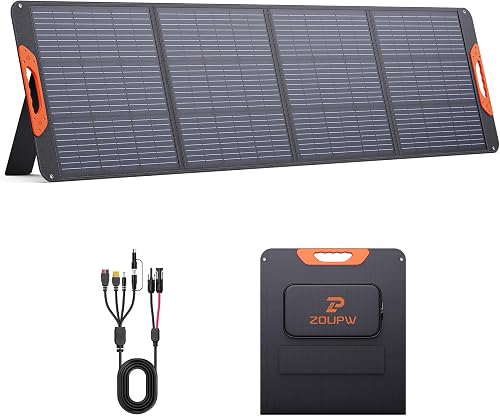
ZOUPW includes a 5-in-1 cable with XT60, Anderson, DC7909, DC8020 and DC5521 connectors. That selection may cover your station without a separate adapter, but check voltage and input limits for your exact model.
The panel weighs 18.96 lb and folds to 25 x 21.06 x 1.97 in. Four kickstands help angle it, while USB-C PD rated at 60W and a USB-A port can charge devices directly.
ZOUPW gives the panel body an IP67 rating and says the junction box and connected cables are not fully waterproof. Keep those electrical connections dry when using it outdoors.
Consider it if you want multiple adapter types in the box and a 200W rating. Skip it if you expect the cable connections or junction box to sit in wet conditions, or if its weight is too much to carry.
7. ZOUPW 100W Portable Solar Panel: Best for 100W multi-connector charging
ZOUPW 100W Portable Solar Panel: Best for small stations
- 100W rating
- 23.5% efficiency claim
- 5-in-1 cable
- Two adjustable kickstands
This lower-output panel includes a 5-in-1 cable and direct USB charging ports. Its listed compatibility includes several Jackery, EcoFlow, Anker and Bluetti models.
Pros
- 5-in-1 cable included
- USB-C and USB-A ports
- IP67 panel rating
Cons
- 100W rated output
- Keep the controller and cables dry
The 100W ZOUPW is lighter than the brand’s 200W panel and includes five connector types in its cable. Its 9.48 lb weight and 24.13 x 21.06 x 1.77 in folded size make it easier to carry than the 200W ZOUPW.
Two kickstands let you angle the panel, and its built-in controller has USB-C and two USB-A ports for direct device charging. ZOUPW names compatibility with several Jackery, EcoFlow, Anker and Bluetti models.
The panel body is rated IP67, but ZOUPW says the controller and cables are not fully waterproof. Keep them dry, and remember that the station’s input limit can cap the power it accepts.
Choose it for a lighter kit with several connection options and modest charging needs. Skip it if you want to recharge a large power station as quickly as conditions allow; its rated output is 100W.
8. HQST 200W Portable Solar Panel: Best for a lighter 200W panel
HQST 200W Portable Solar Panel: Best for lighter 200W carry
- 200W rating
- 16BB N-Type cells
- 11.82 lb claim
- 3-in-1 adapter cable
HQST highlights a lighter build and includes a 3-in-1 adapter cable for several common station inputs. Check the station’s voltage and power limits.
Pros
- 200W rating
- 3-in-1 cable included
- Adjustable kickstands
Cons
- Weight claims differ across specifications
- Cable has only 3 connector types
HQST’s 200W panel includes a 3-in-1 adapter cable with XT60, DC7909 and DC5521 connectors. HQST highlights a weight of 11.82 lb, while another specification gives 11 lb.
Two kickstands adjust from 40 to 60 degrees for positioning. HQST describes N-type cells and a fully laminated build, with an IP67 rating for rain and splashes.
The included cable has three connector types. HQST names compatibility with several Jackery, EcoFlow, Bluetti, Goal Zero and Anker stations, subject to their voltage and power limits.
Consider it if you want a 200W panel and a lighter carry than many panels in this group. Skip it if your station needs a connector outside the three included options, and confirm the final fit before setup.
9. Jackery SolarSaga 100W Air: Best for a small packed size
Jackery SolarSaga 100W Air: Best for compact storage
- 100W rating
- 7 lb
- Bifacial design
- W-fold design
A 7 lb bifacial panel with a W-fold design suits trips where packed size matters. Jackery says it is not compatible with Explorer 300 or 300 v2.
Pros
- Lightest pick here
- Bifacial design
- Integrated stand
Cons
- Not compatible with Explorer 300 or 300 v2
- Confirm connector fit for other stations
At 7 lb, the SolarSaga 100W Air is the lightest pick here. Its W-fold design is made for compact storage, and it has an integrated stand for setup on a balcony, in a backyard or at a campsite.
Jackery describes it as a bifacial panel with 23% efficiency and an IP68 rating. It has a sun indicator to help with angle, plus USB ports for charging devices directly.
Jackery says the 100W Air is not compatible with the Explorer 300 or Explorer 300 v2 because of a voltage mismatch. Check compatibility for any other station before buying.
Choose it when low carry weight and compact storage matter more than rated output. Skip it for an Explorer 300 or 300 v2, and for any other station whose input requirements you have not confirmed.
10. EBL 200W Portable Solar Panel: Best for a basic 4-in-1 cable kit
EBL 200W Portable Solar Panel: Best for bundled adapters
- 200W rating
- 23.5% efficiency claim
- MC4 to 4-in-1 cable
- Four kickstands
EBL includes an MC4 cable with four connector types for a range of station inputs. Check the specific connector and electrical requirements for your model.
Pros
- 4-in-1 cable included
- Four kickstands
- Foldable
Cons
- Heavier than several 200W picks
- IP65 rating is not the same as submersion protection
EBL pairs a 200W rating with an MC4 cable that includes XT60, Anderson, DC7909 and aviation connectors. Its four kickstands support setup at a campsite or during a power outage.
The panel weighs 17.95 lb and folds to 25.31 x 20.87 x 2.17 in. EBL describes PET lamination and an IP65 waterproof rating.
Check that the included connector fits your power station and that the station can accept the panel’s voltage and current. The cable’s connector options don’t replace checking the station manual.
Pick it if you want a 200W panel with a multi-connector cable included. Skip it if you’re minimizing pack weight or folded thickness.
How do you set up and care for a portable solar panel?
Set up a portable solar panel on a stable surface in direct, unshaded light, angle it toward the sun, and connect it only after checking the station’s input limits. A little repositioning through the day can help the panel receive stronger sunlight.
Unfold the panel on ground or a clear outdoor surface with enough room for its kickstands. Point it toward the sun and use the angle adjustment provided; the Renogy 200W offers 40, 50 or 60 degree positions, while EcoFlow’s bracket adjusts from 30 to 60 degrees.
Before connecting, inspect the cable and confirm the connector matches the station’s solar input. Keep the connection point, cable ends and any controller dry, even when a panel body has a water resistance rating.
Once charging begins, check the station’s display or app for solar input. If the reading is lower than expected, look for partial shade, a poor angle, loose connections or an input limit that is lower than the panel’s rating.
After use, disconnect the panel according to its instructions, fold it carefully and store it dry. Avoid dragging it across rough ground or leaving cables under tension, which can strain connections.
What common solar panel buying mistakes should you avoid?
The most common mistakes are buying by wattage alone, assuming a matching plug proves compatibility, and leaving the panel in shade. A short check of the station manual prevents many avoidable pairing problems.
First, don’t assume any panel works with any power station. The station’s voltage, current and connector limits matter, and adapters do not change those limits.
Second, don’t expect the rated wattage throughout the day. A 200W rating is measured under suitable conditions; clouds, angle, temperature and shade can reduce output, while the station can cap accepted power.
Third, don’t overlook cable weather limits. Some panels are rated for outdoor exposure, but their cable, controller or junction box may need to stay dry.
Finally, don’t choose a heavier, higher-output panel for a trip where you’ll carry it far and only charge a phone or small devices. A 100W option may fit that job better and take less effort to transport.
Is a 100W or 200W solar panel better?
A 100W panel is easier to carry, while a 200W panel has a higher rated output for charging a compatible station. The right choice depends on how much weight you’ll carry, your station’s input ceiling and how long you can leave the panel in the sun.
The Renogy 100W weighs 8.86 lb, and the Jackery SolarSaga 100W Air weighs 7 lb. The 200W picks range from HQST’s stated 11.82 lb to ZOUPW’s 18.96 lb.
Don’t assume a 200W rating means twice the charging speed. Your station’s input limit, panel angle, shade and cloud cover affect how much power reaches the battery.
Do bifacial solar panels help with a power station?
A bifacial panel can collect sunlight from both sides, but the benefit depends on how much light reaches the back of the panel. A dark surface or close placement against the ground may leave little extra light to capture.
The Jackery SolarSaga 200W and EcoFlow 220W are described as bifacial. Jackery states up to 26.7% efficiency, while EcoFlow states up to 25% and says its dual-sided design can collect more energy.
Treat those figures as brand claims rather than guaranteed charging results. Compare connection, weight and station compatibility first, then consider bifacial design as one feature among several.
What is the best solar panel for a portable power station?
The Renogy 200W Portable Solar Panel is the best solar panel for many portable power station owners who want a compact fold, USB charging and a 200W rating. Choose the Jackery SolarSaga 200W for a compatible Jackery station, EcoFlow’s 220W panel for its higher rated output, or a 100W pick when low carry weight matters most.
Before you buy, check the station’s solar input range and cable connection. If you’re choosing the station and panel as a pair, our guide to solar generator kits can help you compare bundled options.
Our top 3 picks at a glance
-
1
-
2
-
3
Frequently asked questions
How many watts should a solar panel have for a portable power station?
Choose a panel wattage that stays within your power station’s solar input range. A 100W panel is easier to carry but charges more slowly than a 200W panel in suitable sunlight.
The station may limit how much power it accepts, so a higher-rated panel won’t always mean faster charging.
Can any solar panel charge a portable power station?
No. The panel’s connector, voltage and current must fit the power station’s solar input requirements.
Some panels include several adapters, while others use MC4 or a brand-specific connector.
Confirm the exact station model and its manual before connecting a panel.
Do portable solar panels produce their rated wattage?
Not consistently. Rated output assumes suitable conditions, while shade, clouds, panel angle and temperature can reduce the power reaching your station.
Place the panel in direct, unshaded sun and adjust its angle as the sun moves.
The station’s input limit can also cap charging.
Can I use a solar panel while running a power station?
Many power stations allow charging while powering devices, but the feature depends on the model and its operating limits.
Check your station’s manual for pass-through charging guidance, then see our guide to charging a power station while using it.
How long does a portable power station take to charge from solar?
It depends on battery capacity, panel output, sunlight and the station’s maximum solar input. Clouds, shade and poor panel angle can extend charging time.
Use the station’s accepted input and the panel’s rated output as a starting point, then see our guide to solar charging times.