Best 2000W Portable Power Stations for Storm Outages: Top 8 Picks (October 2026)
The best 2000W portable power stations for storm outages include the Jackery Explorer 2000 v2 for a lighter 2kWh backup, the Anker SOLIX C2000 Gen 2 for higher rated output, and the EcoFlow Delta 3 Max for fast outage transfer.
On this page (9 sections)
- How we chose 2000W portable power stations for outages
- Compare the best 2000W power stations
- Best 2000W portable power stations for storm outages
- What can a 2000W power station run during an outage?
- How much battery capacity do you need for a storm?
- What should you check before connecting appliances?
- How should you recharge during a long outage?
- Which 2000W portable power station should you choose?
- Related questions
The best 2000W portable power station for most storm outages is the Jackery Explorer 2000 v2, with 2,042Wh capacity, 2,200W AC output and a stated weight of 39.5 lb. Choose Anker for 2,400W rated output and expansion to 4kWh, or Bluetti when 2,600W continuous output matters more than carry weight.
A 2kWh battery can help keep selected essentials running, but it won't power every home appliance indefinitely. Start with the devices you need most, then compare their running watts, startup needs and total energy use with the station's output and capacity.
For a basic outage plan, see our storm backup guide. If you're new to battery stations, what a portable power station is explains the main parts and limits.
Our picks at a glance
-
1
-
2

-
3

How we chose 2000W portable power stations for outages
We compared the stated capacity, continuous output, surge or boost modes, charging options, port count, weight and backup features for each model. Our score weighs those specs and features against what matters when you need power through a storm outage.
A 2,000W label alone doesn't tell you how long a station will run a device. Capacity, expressed in watt-hours, gives a better starting point for estimating energy available, while inverter output indicates what loads the unit can support at once.
The picks include several units around 2kWh, plus the lighter OUPES Mega 1. It has 2,000W continuous output but only 1,024Wh of built-in capacity, so it fits a different balance of portability and runtime.
Compare the best 2000W power stations
The Jackery is the lightest full-capacity option in this group, while the Bluetti has the highest stated continuous output among the full-capacity picks. Compare the details before choosing by brand or headline wattage.
| Product | Best for | Capacity | AC output | Weight | Our score |
|---|---|---|---|---|---|
| Jackery Explorer 2000 v2 | a lighter 2kWh backup | 2,042Wh | 2,200W | 39.5 lb | 8.8 |
| Anker SOLIX C2000 Gen 2 | higher rated output | 2,048Wh | 2,400W rated, 4,000W peak | 41.7 lb | 8.7 |
| EcoFlow Delta 3 Max | fast outage transfer | 2,048Wh | 2,400W | 8.6 | |
| Bluetti Elite 200 V2 | 2,600W continuous output | 2,073.6Wh | 2,600W continuous | 53.4 lb | 8.5 |
| DJI Power 2000 | many connected devices | 2,048Wh | 8.3 | ||
| OUPES Mega 1 | a lighter 2,000W inverter | 1,024Wh | 2,000W continuous | 27.8 lb | 8.0 |
| DABBSSON 2000L | more AC outlets | 2,048Wh | 2,200W continuous | 7.6 | |
| EBL 2400W Power Station | a broad mix of ports | 1,843.2Wh | 2,400W | 54 lb | 7.4 |
Best 2000W portable power stations for storm outages
The right pick depends on which loads you plan to run, how often you may need to recharge, and whether you'll move the unit by hand. Read each model's limits against your actual appliances.
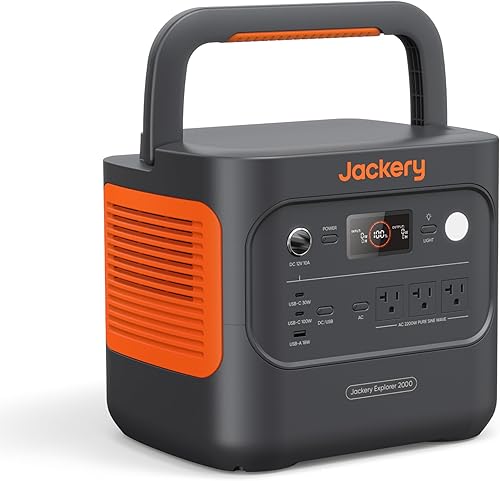
Jackery Explorer 2000 v2: Best for a lighter 2kWh backup
- 2,042Wh capacity
- 2,200W AC output
- 39.5 lb
- 20ms UPS switching
A 2kWh-class battery and 2,200W AC output suit selected home loads, while its 39.5 lb weight is lower than the other full-capacity picks here.
Pros
- Lightest full-capacity pick here
- 100W USB-C PD port
- 20ms UPS switching
Cons
- Three AC ports
- Solar charging uses a DC8020 cable
The Jackery Explorer 2000 v2 combines 2,042Wh of capacity and 2,200W AC output in a 39.5 lb unit. That makes it the lightest full-capacity pick here, an advantage if you may need to move it between a storage spot and the room where you need backup.
Three AC ports serve household devices, and the 100W USB-C PD port can charge compatible electronics without a separate adapter. Jackery states that the unit can switch in 20ms for UPS use, and it offers a silent charging mode below 30dB.
AC fast charging can take the station from empty to 80% in 66 minutes, according to Jackery. With 400W panels, the brand says solar charging can take as few as 6 hours; the panel is optional.
Pick it if you want a lighter 2kWh-class station for selected home essentials. Before buying, check each appliance's running draw and startup needs against the station's limits.
Anker SOLIX C2000 Gen 2: Best for higher rated output
- 2,048Wh capacity
- 2,400W rated output
- 4,000W peak output
- Expandable to 4kWh
Anker combines 2,048Wh with 2,400W rated output and a 4,000W peak. An expansion battery can raise capacity to 4kWh.
Pros
- Highest rated output in this group
- Expansion option up to 4kWh
- 58-minute full charge with AC and solar
Cons
- Expansion battery is an additional purchase
- Check appliance startup needs against the unit's limits
Anker's SOLIX C2000 Gen 2 gives you 2,400W rated output and 4,000W peak output with 2,048Wh of capacity. That higher rated output may suit a load plan that needs more headroom than the 2,200W options provide, though every connected appliance still needs to fit the station's limits.
Anker says an expansion battery can increase capacity to 4kWh. The unit weighs 41.7 lb, and the brand states it can fully charge in 58 minutes using AC and solar charging.
Anker also says the station uses 9W on standby and can run a dual-door refrigerator for up to 32 hours. Actual runtime varies with the refrigerator and other loads, so use that claim as a reference rather than a promise for your setup.
Choose it if higher rated output and the option to add capacity are priorities. Factor in the separate expansion battery if your outage plan depends on the larger capacity.
EcoFlow Delta 3 Max: Best for fast outage transfer
- 2,048Wh capacity
- 2,400W output
- Less than 10ms transfer time
- 3,400W X-Boost mode
EcoFlow pairs 2,048Wh with 2,400W output and a stated transfer time under 10ms. Its X-Boost mode is rated up to 3,400W.
Pros
- Fast stated transfer time
- 0–80% charging in 1.13 hours
- App controls
Cons
- X-Boost is a separate operating mode
- Confirm each appliance's needs before relying on it
The EcoFlow Delta 3 Max pairs 2,048Wh capacity with 2,400W output and a stated transfer time of less than 10ms. The transfer feature may matter if you want supported devices to switch to battery power quickly during an outage.
EcoFlow says X-Boost can provide up to 3,400W for compatible appliances. Treat that as a separate mode, not the unit's standard output rating, and confirm that your intended device works within the mode's requirements.
The station charges from 0% to 80% in 1.13 hours, according to EcoFlow. App controls let you monitor energy use and set priorities, which may help you track how quickly an outage plan is drawing down the battery.
Pick it if fast transfer and charging features suit your backup setup. Check the appliance's power needs and confirm which operating mode supports them before relying on X-Boost.
Bluetti Elite 200 V2: Best for 2,600W continuous output

- 2,073.6Wh capacity
- 2,600W continuous output
- 3,900W power lifting mode
- Up to 15ms UPS backup
The Elite 200 V2 has the highest stated continuous output among the full-capacity picks here, with 2,600W and 2,073.6Wh.
Pros
- 2,600W continuous output
- Four AC outlets
- Three charging modes
Cons
- Heaviest full-capacity pick here
- Power lifting mode is distinct from continuous output
The Bluetti Elite 200 V2 has 2,600W continuous output, the highest stated continuous rating among the full-capacity models in this roundup. Its 2,073.6Wh battery and four AC outlets give you room to connect several devices, as long as their combined load stays within the station's limits.
Bluetti also specifies a 3,900W power lifting mode. This is distinct from continuous output, so don't assume it will support any appliance that exceeds 2,600W without checking compatibility and operating guidance.
The Elite 200 V2 weighs 53.4 lb. Bluetti says its Turbo mode can charge the unit from 0% to 80% in 50 minutes, while Standard and Silent modes trade charging speed for other priorities.
Choose it when continuous output is the deciding factor and you can manage its weight. Compare your appliances' startup and running demands with the continuous rating before making it your outage hub.
DJI Power 2000: Best for many connected devices

- 2,048Wh capacity
- 15 ports
- 10ms UPS switching
- Expansion up to 22.5kWh
DJI's 15 ports help when several people need to charge devices at once. Its capacity can expand up to 22.5kWh with separately sold expansion batteries.
Pros
- 15 ports
- 10ms UPS switching
- Expansion option
Cons
- Solar charging needs a separate compatible adapter
- Expansion batteries are sold separately
DJI Power 2000 suits a household where multiple people need to plug in devices. It has 15 ports, including dual full SDC ports, and a 2,048Wh battery for a mix of devices during an outage.
DJI states a 10ms UPS switch time and expansion support up to 22.5kWh with separately sold expansion batteries. It also says the station recharges to 80% in 55 minutes.
One setup detail matters for solar: the MPPT and car charging modules are not built in. Connecting a solar panel or car battery requires a separate compatible adapter, so include that equipment in your plan.
Pick it if port count and future expansion matter to your household. Check the accessories needed for your recharge plan before choosing it for storm backup.
OUPES Mega 1: Best for a lighter 2,000W inverter

- 1,024Wh capacity
- 2,000W continuous output
- 4,500W surge
- Expandable up to 5,120Wh
This lighter option delivers 2,000W continuous output, but its 1,024Wh capacity is about half that of the 2kWh-class picks. It can expand with up to two B2 batteries.
Pros
- Lightest unit in this roundup
- 2,000W continuous output
- Expansion option
Cons
- Lower capacity without expansion
- Expansion batteries add bulk and cost
The OUPES Mega 1 is the lightest station here at 27.8 lb, with 2,000W continuous output and 1,024Wh capacity. That lower capacity makes it better suited to shorter runs or a smaller set of essentials than the 2kWh-class models.
OUPES says the Mega 1 can expand to 5,120Wh by connecting up to two B2 extra batteries. It also states an AC recharge time of 36 minutes from empty to 80%, with faster charging claimed when AC and solar inputs are combined.
Its stated surge output is 4,500W, and it has a UPS transfer time under 20ms. Check your appliance's starting needs and the exact expansion setup if you plan to use it for more than brief backup.
Consider it if low carry weight matters and you can work within its smaller base capacity. Add the cost and storage needs of expansion batteries to your decision.
DABBSSON 2000L: Best for more AC outlets

- 2,048Wh capacity
- 2,200W continuous output
- Six AC outlets
- 3,300W power boost
DABBSSON combines 2,048Wh with 2,200W continuous output and six AC outlets. Its 41 lb weight is close to the lighter full-capacity options.
Pros
- Six AC outlets
- 2,200W continuous output
- AC, solar and car charging
Cons
- Power boost differs from continuous output
- Check charging accessories for your setup
DABBSSON 2000L offers 2,200W continuous output, 2,048Wh capacity and six AC outlets. The outlet count may help when several household devices need AC power, while its stated 41 lb weight is close to the lighter full-capacity models.
The station supports AC, solar and 12V car charging, with a stated solar input limit of up to 800W. DABBSSON says it can recharge fully in 1 hour from AC, and the unit has an EPS transfer time under 15ms.
Its 3,300W power boost differs from the 2,200W continuous rating. Check whether your intended appliance is compatible with that mode and make sure the rest of your connected load stays within the proper limit.
Choose it if six AC outlets and multiple recharge options fit your plan. Confirm your solar or car charging accessories before an outage, rather than during one.
EBL 2400W Power Station: Best for a broad mix of ports

- 1,843.2Wh capacity
- 2,400W output
- 12-device charging
- 54 lb
EBL offers 2,400W output and a broad port mix for charging up to 12 devices. Its 1,843.2Wh capacity is below the other full-size units here.
Pros
- Many port types
- 2,400W output
- Emergency backup mode
Cons
- Heaviest unit in this roundup
- Lower capacity than other full-size picks
The EBL 2400W Power Station supplies 2,400W output with 1,843.2Wh of capacity. Its port mix includes four AC outlets, two USB-A ports, two USB-C ports, two DC ports, a car port and wireless charging.
EBL says it can charge up to 12 devices at once and includes an emergency power mode that switches to backup in 0.1 seconds. Those features suit a group with many small devices, though high-draw appliances will use capacity faster than phones or lights.
At 54 lb, it's the heaviest unit in this roundup. Its capacity is also lower than the other full-capacity picks, so plan which loads take priority if an outage lasts longer than expected.
Pick it if connection options matter more than low carry weight. Compare the 1,843.2Wh capacity with your expected usage before treating it as a long-duration home backup source.
What can a 2000W power station run during an outage?
A 2,000W-class station can run devices whose combined draw stays within its output limit, but a large motor may need extra power to start. Check the label or manual for each appliance's running watts and startup demand before connecting it.
A refrigerator, router, lights, phones and a laptop can be sensible candidates for a prioritized outage plan, depending on their actual power needs. High-draw appliances such as kettles, heaters and window air conditioners need closer checking because they can use substantial output or drain the battery quickly.
Use the guide to what a power station can run to estimate your likely loads. For a smaller unit comparison, see what a 500W power station can run.
How much battery capacity do you need for a storm?
Battery capacity matters most when you need devices to run for hours between charges. A station with about 2,000Wh stores more energy than the OUPES Mega 1's 1,024Wh base battery, but actual runtime depends on the connected load and conversion losses.
Make a short list of essentials and estimate how long each needs to run. Add their energy use together, then leave a margin for startup surges, changing appliance cycles and the fact that a battery's full rated capacity may not reach your devices as usable AC energy.
For a broader sizing method, read how to choose a portable power station. If the list of loads does not fit comfortably, compare a larger unit in our 3000W portable power station guide.
What should you check before connecting appliances?
Check both continuous output and startup or surge limits before plugging in a motor-driven appliance. A station's peak rating or boost mode is not the same as its continuous output, and modes may only work with compatible loads.
Read the appliance manual, add together the devices you plan to run at the same time, and keep the total within the station's stated limits. Give priority to essentials such as communication devices, a refrigerator or medical equipment that has a separate backup plan.
Keep the power station dry and follow its instructions for indoor placement and charging. Our guide to using a power station indoors covers placement basics, while the sump pump backup guide walks through motor startup checks.
How should you recharge during a long outage?
A recharge plan can extend a station's usefulness, but charging speed depends on the input method and setup. AC charging may be fast when grid power returns, while solar needs suitable panels, sunlight and compatible cables or adapters.
Before a storm, charge the station and identify the correct cables for the method you expect to use. The Jackery, for example, uses a DC8020 solar charging cable, and DJI requires a separate compatible adapter for solar charging.
When power returns, recharge before using the station for lower-priority devices. Our portable power station charging time guide explains the factors that affect recharge time.
Which 2000W portable power station should you choose?
Choose the Jackery Explorer 2000 v2 if you want a lighter full-capacity station for selected home essentials. Pick the Anker SOLIX C2000 Gen 2 if you need more rated output and may add an expansion battery, or the Bluetti Elite 200 V2 if 2,600W continuous output is the key requirement.
For a smaller load plan where easy carrying matters, the OUPES Mega 1 has 2,000W continuous output but half the base capacity of the 2kWh-class picks. If none of these units gives you enough output or capacity for your load list, compare the best 3000W portable power stations before settling on a backup plan.
Related questions
What does a 2000W power station mean for appliance use?
A 2000W rating describes the power the station can supply at once, subject to its continuous and surge limits. It does not promise a set runtime, because runtime depends on battery capacity and the devices connected.
Compare both numbers with your appliance needs. A device that draws more than the continuous limit may not run, even if the battery has plenty of watt-hours remaining.
Can a 2000W portable power station run a sump pump?
It can run some sump pumps if their running draw and startup surge fit the station's limits. Check the pump's manual and consider what else will be connected at the same time.
A pump may cycle on and off during heavy rain, so remaining battery capacity matters too. Use the sump pump power station guide to work through the details.
How long will a power station run a refrigerator?
There isn't one runtime that fits every refrigerator and battery station. Compressor cycles, refrigerator size, room temperature, door openings and other connected loads all affect battery use.
Estimate the fridge's daily energy use if you can, then compare it with the station's watt-hour capacity. Leave room for losses and other devices in your outage plan.
Can you charge a power station while using it?
Some models support charging while powering devices, but the approved setup can vary by model and input method. Check the manual for pass-through charging guidance before connecting both a charger and appliances.
Our article on charging a power station while using it explains what to check before relying on this setup during an outage.
Our top 3 picks at a glance
-
1
-
2
-
3
Frequently asked questions
What does 2000W mean on a portable power station?
The watt figure describes the power a station can deliver at one time, subject to its stated continuous and surge limits. It does not tell you how long the battery will run a device.
Check both watts and watt-hours against your appliances.
Our guide to watts and watt-hours explains the difference.
Can a 2000W power station run a refrigerator during an outage?
Often, if the refrigerator's running draw and startup surge stay within the station's limits. Check the appliance label or manual, then compare its startup demand with the station's continuous and peak output.
Battery runtime also depends on the refrigerator's cycling and other connected loads.
How long can a 2,000Wh power station run essentials?
Runtime depends on the total energy the connected devices use and power conversion losses. A 100W load cannot be assumed to run for exactly 20 hours, so treat simple capacity divided by watts as a rough estimate.
For a practical load plan, see what a power station can run.
Is a 2000W portable power station enough for a sump pump?
It may be, if the pump's startup surge and running draw fit the station's output limits. Check the pump label or manual and account for other devices using power at the same time.
Our sump pump backup guide covers the checks to make.
Can you use a portable power station indoors during a storm?
Battery power stations do not burn fuel while supplying electricity, but follow the model's manual for placement, ventilation, temperature and charging. Keep cords away from standing water and protect the unit from rain.
Read our guide to using a power station indoors.


