Best 3000W Portable Power Stations for Long Outages: Top 7 Picks (October 2026)
The best 3000W portable power stations for long outages include the EcoFlow Delta Pro for expandable home backup, the Anker SOLIX F3000 for standby efficiency, and the Jackery HomePower 3600 Plus for rolling home backup.
On this page (9 sections)
- How we chose 3000W portable power stations
- Compare 3000W power stations by capacity and output
- The best 3000W portable power stations for long outages
- How do you choose the right 3000W portable power station?
- How much battery capacity do you need for a long outage?
- When does a 3000W station need expansion?
- How should you set up and care for a 3000W power station?
- What common mistakes should you avoid?
- Which 3000W power station fits your outage plan?
The best 3000W portable power station for most long outages is the EcoFlow Delta Pro, with 3,600Wh of capacity and a path to 25kWh. Anker SOLIX F3000 emphasizes low idle use, while Jackery HomePower 3600 Plus has wheels and a telescopic handle.
A 3,000W output rating tells you what a station may run at one time, not how long the battery lasts. For an outage plan, compare output, stored energy, startup demands, charging options and the space available for a heavy unit.
If you want to compare a smaller backup class first, see our 2000W portable power station picks. For appliance sizing, start with what a power station's watt-hours mean.
Our picks at a glance
-
1

-
2
-
3

How we chose 3000W portable power stations
We compared stated output, battery capacity, expansion options, charging methods, port selection and outage features. Scores reflect how these features fit a long-outage backup plan.
A larger watt-hour figure can support more energy use, but it doesn't guarantee a fixed runtime. Appliances cycle, conversion uses some power, and the actual load changes throughout the day.
A 3,000W-class station may still be a poor match if your equipment needs 240V and the unit only supplies 120V. Check the appliance label and the power station's supported output before choosing.
Compare 3000W power stations by capacity and output
These picks combine about 2,765Wh or more of capacity with at least 3,600W of stated AC output. The Bluetti Apex 300 offers the highest stated output, but starts with less battery capacity than the others.
| Product | Best for | Capacity | AC output | Expansion | Our score |
|---|---|---|---|---|---|
| EcoFlow Delta Pro | expandable home backup | 3,600Wh | 3,600W | Up to 25kWh with extra batteries or Smart Generators | 8.6 |
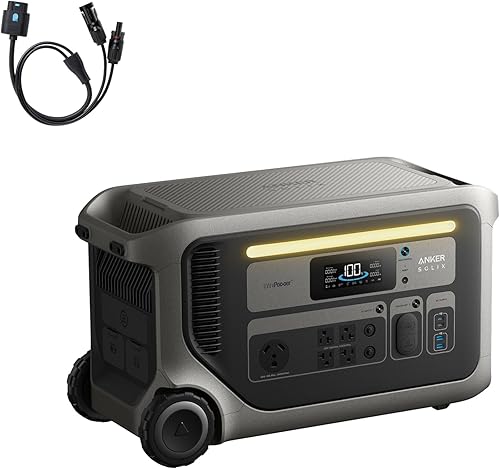
| Anker SOLIX F3000 | standby efficiency | 3,072Wh | 3,600W | Up to 24kWh with extra batteries | 8.5 |
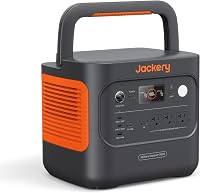
| Jackery HomePower 3600 Plus | rolling home backup | 3,584Wh | 3,600W | Up to 21kWh per unit | 8.4 |
| Jackery HomePower 3000 | quick device transfer | 3,072Wh | 3,600W | 8.3 | |
| EcoFlow Delta 3 Ultra | quiet nights | 3,072Wh | 3,600W | 8.1 | |
| Pecron F3000LFP | multi-device charging | 3,072Wh | 3,600W | 7.9 | |
| Bluetti Apex 300 | voltage flexibility | 2,764.8Wh | 3,840W | 7.8 |
The best 3000W portable power stations for long outages
The right choice depends on stored energy, recharge options, transport and whether your backup system may grow later. Each pick suits a different need, from expansion to quiet operation.
EcoFlow Delta Pro: Best for expandable home backup
- 3,600Wh capacity
- 3,600W AC output
- Expandable to 25kWh
- 15 output methods
The Delta Pro pairs a large starting capacity with several expansion paths. It suits a backup plan that may grow beyond one power station.
Pros
- High starting capacity
- Multiple expansion options
- Five charging methods
Cons
- Weighs 99 lb
- 240V charging figures depend on the input source
EcoFlow Delta Pro leads this group with 3,600Wh of capacity and 3,600W AC output. It can expand from 3.6kWh to 25kWh with compatible extra batteries or Smart Generators, giving a larger backup plan room to grow.
It has five charging methods: EV station, solar, wall outlet, Smart Generator or car outlet. EcoFlow gives a 2.7-hour recharge time with an 1,800W wall outlet and 2.8 hours using four 400W solar panels under its stated conditions.
The 15 output methods include five AC outlets, two 100W USB-C ports, USB-A, DC, car and Anderson connections. This range can simplify a setup with different devices, though you still need to total their power draw.
At 99 lb, this is a substantial unit to move, so plan a storage spot near the equipment you want to power. Choose it if you want a high starting capacity, several charging choices and room to expand; skip it if frequent lifting is part of your plan.
Anker SOLIX F3000: Best for standby efficiency
- 3,072Wh capacity
- 3,600W output
- 125 hours of AC idle standby claimed
- Expandable to 24kWh
Anker highlights low idle consumption and pass-through charging for outage setups that stay ready between uses. Its battery capacity can expand to 24kWh.
Pros
- Low idle draw is a stated focus
- 3,600W pass-through charging
- 120V output and paired 240V setup
Cons
- Weighs 91.5 lb
- 240V output requires pairing two stations
Anker SOLIX F3000 pairs 3,072Wh of capacity with 3,600W output and a stated 3,600W pass-through charging feature. That combination suits a backup setup where you want to recharge from a 120V generator while continuing to run appliances.
Anker highlights low idle use, claiming up to 125 hours of AC idle standby. It also gives an example of a 190W refrigerator running for 42 hours, but your refrigerator's energy use and cycling pattern may differ.
The station supports up to 2,400W of solar input through its 165V or 60V ports and can expand to 24kWh with extra batteries. Two stations can be paired for 240V output, so check whether that larger setup fits your space and budget.
At 91.5 lb, moving it calls for planning. Choose it if low standby use, generator pass-through charging and expansion are priorities; skip it if you need one station that supplies 240V on its own.
Jackery HomePower 3600 Plus: Best for rolling home backup
- 3,584Wh capacity
- 3,600W output
- Wheels and telescopic handle
- Expandable to 21kWh per unit
Jackery combines a 3.6kWh-class capacity with wheels and a telescopic handle. Its 120V and 240V setup requires parallel operation for 240V.
Pros
- Wheeled, telescoping-handle design
- Can expand per unit
- Hybrid AC and DC charging option
Cons
- 240V requires parallel units
- Weighs 77.2 lb
Jackery HomePower 3600 Plus starts with 3,584Wh and supplies 3,600W of output. It can expand to 21kWh per unit, or 43kWh with multiple units, according to Jackery's stated system options.
Its wheels and telescopic handle help when moving the station between storage and the area where you need backup power. It weighs 77.2 lb, so rolling it doesn't remove the need to check doorways, floor transitions and the storage location.
Jackery lists four charging options: hybrid AC and DC, AC, solar and a gas generator. Its stated recharge times are 2 hours for hybrid AC and DC, 2.5 hours for AC, 4 hours for solar and 2.5 hours for a gas generator.
The unit provides 120V output, while 240V requires parallel operation. Choose it if wheeled transport and expansion matter; skip it if you need 240V from a single unit or can't accommodate its size.
Jackery HomePower 3000: Best for quick device transfer

- 3,072Wh capacity
- 3,600W output
- UPS switches within 20ms
- 59.5 lb
The HomePower 3000 offers a UPS mode for devices that need a fast transfer during an outage. Its stated capacity is lower than the 3,584Wh Jackery model.
Pros
- UPS transfer within 20ms
- Built-in TT-30 RV port
- Lighter than the other listed 3kWh-class units
Cons
- No expansion capacity stated
- Solar recharge time depends on compatible panels
Jackery HomePower 3000 offers 3,072Wh of capacity and 3,600W output, with a stated 7,200W surge rating. Its UPS switches within 20ms, which may suit selected devices that need a quick transfer when grid power drops.
This feature is most relevant to devices such as routers or security cameras that should keep running through a brief interruption. Check each device's requirements and whether that transfer time works for it.
A built-in TT-30 RV port adds an option for RV use, and dual 100W USB-C ports can charge compatible devices. Jackery's 15-hour household runtime example depends on the loads connected, so use your own load estimate when planning.
At 59.5 lb, it's the lightest option here with a stated capacity above 3,000Wh. Choose it if you value the UPS feature, RV connection and easier handling; skip it if you need a stated battery expansion path.
EcoFlow Delta 3 Ultra: Best for quiet nights

- 3,072Wh capacity
- 3,600W continuous output
- Under-10ms UPS claim
- 25dB under load claimed
The Delta 3 Ultra pairs 3,600W continuous output with a claimed under-10ms UPS transfer and quiet operation. Its capacity is 3,072Wh.
Pros
- Fast UPS transfer claim
- Quiet operation claim
- Four charging options
Cons
- Expansion capacity is not stated
- Weight is 72.1 lb
EcoFlow Delta 3 Ultra combines 3,072Wh with 3,600W continuous output. EcoFlow claims an under-10ms UPS transfer, a 7,200W surge rating and operation at 25dB under load.
Those features suit buyers who value quiet operation and fast transfer for selected devices, such as a router or PC overnight. The station offers four charging options: wall outlet, solar, car input or EcoFlow Smart Generator.
Its 72.1 lb weight is easier to manage than several larger-capacity models here, but it remains a heavy appliance. Capacity expansion isn't stated for this model, so plan around its built-in battery unless you confirm a supported expansion system.
Choose it if quiet operation and UPS features rank high in your outage plan. Skip it if your priority is expanding capacity, or if you need less output: our 1000W portable power station picks for home use compare smaller options.
Pecron F3000LFP: Best for multi-device charging

- 3,072Wh capacity
- 3,600W output
- 13 ports
- Expandable to 10,752Wh
Pecron offers 13 ports and a 3,072Wh battery for running or charging several devices. It provides 120V AC input and output, not 240V.
Pros
- 13 ports
- Expansion up to 10,752Wh
- AC charging is stated to take 2 hours
Cons
- 120V only
- Extra battery needs a separate cable
Pecron F3000LFP gives you 3,072Wh, 3,600W output and 13 ports. Its stated expansion ceiling is 10,752Wh, adding capacity while staying below the largest expansion options in this group.
It supports AC, solar and car charging, with up to 1,600W solar input. Pecron states that AC charging can recharge the unit in 2 hours, and its UPS mode switches in 8 to 20ms.
The key limit is voltage: the F3000LFP supplies and accepts 120V AC, not 240V. Extra battery expansion also needs a separate XT120-M cascade cable.
Choose Pecron if you want many ports, 120V backup and an expansion option. Skip it if your plan depends on a 240V appliance or you want an expansion setup without a separate cable.
Bluetti Apex 300: Best for voltage flexibility
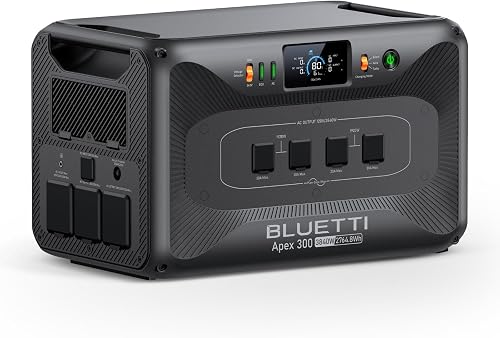
- 2,764.8Wh capacity
- 3,840W AC output
- 120V and 240V options
- Expandable with extra batteries
The Apex 300 has less starting capacity than the other picks, with expansion options and 120V/240V output flexibility. Its setup may suit buyers building a system over time.
Pros
- 120V and 240V options
- Expandable with extra batteries
- Multiple charging sources
Cons
- Lowest starting capacity in this group
- 240V setup details depend on configuration
Bluetti Apex 300 has the highest stated AC output here at 3,840W, with a starting capacity of 2,764.8Wh. It supports expansion with B300K or B500K batteries and offers 120V and 240V options through its system configuration.
Its charging inputs include AC, solar, car and generator, with hybrid AC and solar charging also supported. Bluetti says the system supports black start, which lets it restart using solar or another method after a full power loss.
The starting battery is smaller than the other options in this roundup, so compare expected energy use carefully. Output capacity and stored energy solve different problems: watts help determine what can run at once, while watt-hours help estimate duration.
Choose Apex 300 if voltage flexibility and a system you can expand matter more than starting with a larger battery. Skip it if you want the most stored energy before adding extra batteries, or if you don't want to check which accessories a 240V setup requires.
How do you choose the right 3000W portable power station?
Choose a station by matching its output to the devices you need to run, then matching its battery capacity to the hours you want them powered. After that, check voltage, recharge options, expansion, weight and the space available.
Start with a short list of essential loads. Include a refrigerator, router, lights, medical equipment or pump only if they are part of your plan, and note how many hours each should run.
Then check both running and startup power for each appliance. Motors can draw more power when starting, so a station that covers normal running wattage may still be a poor match for the initial surge.
Capacity is the next check. Add the watt-hours you expect to use, allow for conversion losses and changing loads.
Leave reserve for unexpected needs. Our guide to watts and watt-hours explains how the two ratings answer different questions.
Finally, match the outlets and charging method to your setup. A 120V unit won't directly serve a 240V appliance unless the brand supports a compatible configuration, and some paired systems need extra equipment.
How much battery capacity do you need for a long outage?
Estimate energy use before choosing a power station, because a high output rating doesn't guarantee long runtime. Add the watt-hours for the devices you plan to use, then leave extra capacity for conversion losses and changing loads.
A refrigerator cycles on and off, while a heater or microwave can draw substantial power whenever it runs. Write down which loads matter most, how many hours each will operate, and whether you can turn some off overnight.
For a pump, check both running watts and startup surge. Our guide to whether a portable power station can run a sump pump explains the motor-start check.
When does a 3000W station need expansion?
Expansion helps when your planned energy use exceeds the station's starting capacity or you want more reserve between recharges. EcoFlow, Anker, Jackery HomePower 3600 Plus, Pecron and Bluetti state expansion options, though their limits and accessories differ.
A larger battery doesn't raise the station's output limit by itself. If a device needs more power than the inverter can provide, extra watt-hours won't solve that problem.
Build expansion into your plan only after checking compatible batteries, cables and system configuration. A station that can expand may still need separate accessories and a specific setup.
How should you set up and care for a 3000W power station?
Set up the station in a dry, stable place with enough room to reach its controls and connect its cables. Before an outage, charge it using a supported source and learn which outlets, display readings and app settings control your intended loads.
Connect only the devices you need, then check the displayed input and output as you add each one. This makes it easier to catch an overloaded output or an appliance that draws more power than expected.
Keep charging cables and any expansion accessories together with the station. For a longer outage, plan how you'll recharge it from solar, a generator or another supported source, and follow the unit's manual for storage and charging care.
These units weigh from 59.5 to 99 lb, so consider where you'll store and operate one before moving it. If it will run indoors, read our guide to using a portable power station indoors and follow the brand's safety instructions.
What common mistakes should you avoid?
The most common mistake is treating watts and watt-hours as the same rating. Watts help you judge whether a station can run a load; watt-hours help you estimate how long it may run.
Don't assume a station's surge number is its continuous output, or that every appliance with a low running draw will start successfully. Check both figures for the appliance and the station.
Avoid planning a home circuit around a 240V requirement when the station only supplies 120V. Paired configurations may support 240V, but their extra equipment and setup need to fit your plan.
Don't assume solar input will refill a battery at its maximum rate in every condition. The station, panel combination, available sunlight and charging setup all affect the result.
Which 3000W power station fits your outage plan?
Choose the EcoFlow Delta Pro for the largest starting capacity here and room to expand. Pick Anker SOLIX F3000 for low idle use and pass-through charging, or Jackery HomePower 3600 Plus for wheels and a stated 240V parallel setup.
Choose Jackery HomePower 3000 if its UPS feature and RV port suit your devices, EcoFlow Delta 3 Ultra if quiet operation is a priority, Pecron F3000LFP for multiple ports with 120V-only needs, or Bluetti Apex 300 for output and voltage flexibility with a smaller starting battery.
The best 3000W portable power station is the one that covers your real loads, lasts long enough for your plan and can be recharged in the conditions you expect. For a broader buying checklist, read how to choose a portable power station.
Our top 3 picks at a glance
-
1
-
2
-
3
Frequently asked questions
What does 3000W mean on a portable power station?
A 3000W label usually describes how much power the station can supply at once, while watt-hours describe stored energy. Check both ratings: a station may run a device with a high starting draw but still have limited runtime if its battery capacity is small.
Compare continuous output with the appliance's running and startup needs.
How long can a 3000W power station run a refrigerator?
Runtime depends on the refrigerator's energy use, cycling, and the station's usable battery capacity. A 3,000W output rating alone does not tell you how many hours it will run.
Estimate daily energy use in watt-hours and compare it with battery capacity, allowing for conversion losses and other devices.
Can a 3000W portable power station run a sump pump?
It may run a sump pump if the station can handle both the pump's running wattage and its startup surge. Check the pump label or manual for both figures, then compare them with the station's output limits.
See our guide to portable power stations for sump pumps for the key checks.
Can you expand a 3000W power station?
Some models support extra batteries, but the expansion limit and compatible accessories vary. The EcoFlow Delta Pro can expand to 25kWh, Anker SOLIX F3000 to 24kWh, and Jackery HomePower 3600 Plus to 21kWh per unit.
Check the exact system requirements before planning around added capacity.
Should you choose battery capacity or output first?
Choose output first to make sure the station can start and run the appliances you need. Then compare capacity to estimate how long it can keep them on.
For a long outage, charging options and expansion matter too, because a large battery still needs a way to recharge.