Can a Portable Power Station Run a Window Air Conditioner?
Yes, a portable power station can run a window air conditioner if its continuous output covers the AC’s running watts and its surge capacity covers startup. Battery capacity sets the likely runtime.
On this page (8 sections)
- Can a portable power station run a window air conditioner by wattage?
- How many watt-hours do you need to run a window AC?
- How can you measure an air conditioner’s power use?
- Which power station fits your window AC plan?
- How do you set up a power station for a window AC?
- What mistakes shorten runtime or stop an AC from starting?
- How can you make a window AC run longer?
- Can a portable power station run a window air conditioner during an outage?
Yes, a portable power station can run a window air conditioner if its continuous output covers the AC’s running watts and its surge rating covers compressor startup. Watt-hours determine how long the battery can supply that load, so check both output and capacity before choosing a station.
Start with the AC’s label or manual. Find its running watts and startup or surge demand, along with its voltage and plug requirements.
If the AC runs on a compatible 115 V plug, a plug-in electricity monitor can help measure energy use. Use the monitor only within its current and voltage limits.
Can a portable power station run a window air conditioner by wattage?
Yes, when the station can handle both the AC’s running load and the brief power demand when its compressor starts. A peak rating is usually a short-term limit, so compare the AC’s startup demand with the station’s surge instructions, not just the largest number printed in its specs.
The Anker SOLIX C2000 Gen 2 has 2,400 W rated output and 4,000 W peak power. Anker says it can run most window and RV air conditioners, but the AC’s own requirements still determine whether this station is a suitable match.
A station’s rated watts also need to cover any other devices you want to use at the same time. Add their running loads and consider whether a second appliance could start while the AC compressor is running.
How many watt-hours do you need to run a window AC?
Watt-hours measure stored energy, while watts measure how quickly an appliance draws power. Once you know that the station can start and run the AC, capacity helps estimate how long it may keep cooling.
Divide the station’s watt-hours by the AC’s average watts for an idealized estimate. Actual runtime will be shorter because of conversion losses, battery limits, and changes in the compressor’s duty cycle.
For example, a station with about 2,000 Wh does not necessarily provide 2,000 Wh to the AC. Use your AC’s average energy draw, not only the running-watt figure, if you need a realistic estimate.
Our guide to watts and watt-hours explains the difference. For a broader look at essential loads, see what a portable power station can run.
How can you measure an air conditioner’s power use?
A compatible electricity monitor can show how much energy a window AC uses over time. Measure across a representative period because the compressor cycles, and its average draw may be lower than its draw while actively cooling.
The Kill A Watt P4400 is designed for 115 V AC appliances up to 15 A. It can display consumption by kilowatt-hour and track usage by day, week, month, or year.
Check the AC’s plug and current draw against the monitor’s limits before connecting them. Keep every cord, plug, monitor, and outlet within its stated rating, and follow the instructions for both devices.
Which power station fits your window AC plan?
Choose a station by matching output to the AC first, then compare capacity, weight, recharge options, and the other devices you want to run. A higher capacity helps with runtime, but it does not guarantee the compressor can start.
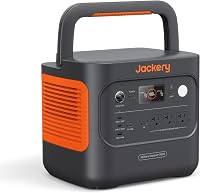
The Jackery Explorer 2000 v2 provides 2,200 W AC output and 2,042 Wh capacity. Its 3 AC ports give you room to connect several devices, while its 20 ms switching feature may suit a backup setup where quick transfer matters.
Choose it if your AC’s running demand fits within 2,200 W and the station’s startup limits cover the compressor. Skip it if your AC needs more output or if your cooling plan depends on longer runtime than its battery can provide.
The Bluetti Elite 200 V2 has 2,600 W continuous AC power and 3,900 W power lifting. It also has 2,073.6 Wh capacity, giving you another combination of output and stored energy to compare with your AC’s needs.
Consider it when your AC’s running watts are within its continuous output and its surge needs fit the station’s operating limits. Skip it if its weight or capacity does not suit your backup plan.
The Anker SOLIX C2000 Gen 2 is a strong option to compare when an AC needs more output headroom. It weighs 41.7 lb and can expand to 4 kWh with an expansion battery, which may help if you want more stored energy and can accommodate the extra equipment.
For a general sizing framework, read how to choose a portable power station. If your outage plan includes a sump pump, see whether a portable power station can run one.
How do you set up a power station for a window AC?
Set up the station in a dry, stable, well-ventilated place, then connect the AC directly if its plug and cord reach safely. Keep the station away from rain, standing water, direct heat, and anything that blocks its vents.
Before an outage, charge the station and confirm that its AC output is enabled. Check that the AC starts and runs without overloading the station, then note the battery use over a short period so you can refine your runtime estimate.
Avoid daisy-chaining extension cords or using an adapter that is not rated for the AC’s load. Follow both manuals for cord use, ventilation, charging, and operating conditions.
What mistakes shorten runtime or stop an AC from starting?
The most common sizing mistake is checking only the AC’s running watts. Compressor startup can need more power, so confirm the station’s surge capability as well as its continuous output.
Another mistake is treating battery capacity as a promise of runtime. A 2,000 Wh station will not necessarily run a 500 W average load for 4 hours because power conversion and other limits reduce usable energy.
Also avoid counting solar charging as guaranteed continuous power. Sunlight, panel placement, and station charging limits affect input, so plan around the battery’s stored energy and treat solar as a possible supplement.
How can you make a window AC run longer?
Reduce the amount of heat entering the room and cool only the space you need. Close doors and windows, use curtains or shade where possible, and choose a comfortable thermostat setting rather than cooling unused rooms.
Keep the AC filter clean as its manual directs, and use energy-saving or fan settings when they suit your situation. Turn off extra devices that are not essential, since each one draws from the same battery.
For more backup planning, review the storm backup guide. If you need help with a different appliance, our guide to portable power station sizing compares stations for broader outage loads.
Can a portable power station run a window air conditioner during an outage?
Yes, if the AC’s startup demand fits the station’s surge limit, its running watts fit the continuous output, and the battery lasts long enough for your cooling plan. Pick the Anker if you need more output headroom or expandable capacity, compare the Jackery for a compatible load with 2,042 Wh capacity, and consider the Bluetti when its 2,600 W continuous output suits your AC.
Skip a battery station if the AC exceeds its output limits or you need cooling for longer than the available energy can support. Measure the AC’s average use, choose a realistic runtime target, and compare that plan with how to choose a portable power station.
Frequently asked questions
Can a portable power station start a window air conditioner?
Yes, if the station’s surge capacity covers the AC’s startup demand and its continuous output covers the running load. Check both figures on the AC label or in its manual, then compare them with the station’s instructions.
If the compressor needs more power at startup than the station can supply, it may not start or the station may shut off.
How long will a power station run a window air conditioner?
Runtime depends on usable battery capacity and the AC’s average draw, which changes as the compressor cycles. Divide watt-hours by average watts for a rough upper estimate, then allow for conversion losses and other connected loads.
A compatible electricity monitor can help you estimate energy use over a representative period.
What size power station do I need for a window AC?
Choose a station whose continuous output meets the AC’s running watts and whose surge capability meets its startup demand. Then choose enough watt-hours for the hours you want to run it.
Start with the AC label or manual.
A large battery cannot make up for an output rating that is too low.
Can I run a window AC and other appliances at the same time?
Yes, if the combined running load stays within the station’s continuous output and startup surges stay within its limits. Add the draw of every device you plan to connect, including appliances that may switch on automatically.
Leave room for the AC compressor and another motor to start around the same time.