Bluetti Elite 100 V2 vs Anker SOLIX C1000 Gen 2: Which Is Better? (November 2026)
Choose the Anker SOLIX C1000 Gen 2 for most buyers. It has higher 2,000W output, faster 49-minute full charging and strong solar and UPS features, while the Bluetti Elite 100 V2 is the better choice for quieter operation and 1,800W everyday backup.
On this page (12 sections)
- Quick verdict: Anker wins for most uses
- Anker SOLIX C1000 Gen 2: the faster all-rounder
- Bluetti Elite 100 V2: the quieter backup choice
- Which has more useful output?
- Which charges faster from a wall outlet?
- Which is better for solar charging?
- Which station is quieter indoors?
- Which handles outages and remote work better?
- Which is easier to carry and store?
- Who should buy each power station?
- Final verdict: choose Anker unless quiet or solar input leads
- For another direct comparison, read Anker SOLIX C1000 vs Bluetti Elite 100 V2: Which to Buy?. For the broadest mix of output, charging and app control, buy the Anker SOLIX C1000 Gen 2.
Choose the Anker SOLIX C1000 Gen 2 for most buyers. In this bluetti elite 100 v2 vs anker solix c1000 gen 2 comparison, Anker wins on output, full-charge speed and compact portability.
Both stations have 1,024Wh capacity, LiFePO4 batteries and 10 ms UPS backup. The main choice is between Anker's 2,000W output and 49-minute full recharge, or Bluetti's 1,800W output, 30dB silent mode and up to 1,000W solar input.
This comparison uses the published specifications and features for each model. It focuses on outage backup, camping, remote work, solar charging, portability and daily use.


Quick verdict: Anker wins for most uses
The Anker SOLIX C1000 Gen 2 is the overall winner because it combines higher output with faster full charging. It delivers 2,000W, reaches 3,000W peak output and can fully recharge at 1,600W in 49 minutes.
That combination gives Anker more room for demanding devices and less waiting between uses. Its 1,024Wh capacity matches the Bluetti, so the advantage comes from output and charging rather than stored energy.
The Bluetti Elite 100 V2 remains a close alternative. It provides 1,800W rated AC output, reaches 80% charge in about 45 minutes, runs at 30dB in silent mode and accepts up to 1,000W of solar input.
Choose Bluetti when quiet indoor operation or larger solar input matters more than the last 200W of AC output. For most emergency backup, remote work and camping buyers, Anker's higher score reflects the more flexible everyday package.
The difference is about how each station fits into a routine. Anker is easier to favor when the station must refill completely between uses, while Bluetti is easier to favor when it will remain indoors or connect to a larger solar setup.
Anker SOLIX C1000 Gen 2: the faster all-rounder
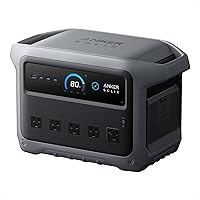
The Anker SOLIX C1000 Gen 2 suits buyers who want higher output and a quick return to full charge. Its 1,024Wh LiFePO4 battery supplies 2,000W through 10 ports, with 3,000W peak output for compatible starting demands.
Anker's 49 Min UltraFast Recharging feature uses 1,600W charging. UltraFast Charging activates when the battery cell temperature is above 20°C, while charging from 0–20°C takes longer.
The station measures 15.1 x 8.2 x 9.6 in and weighs 11.3 kg. Anker describes it as 14% smaller and 11% lighter than similar models, which helps when you move it between a room, vehicle, RV, beach or park.
The Anker app enables UltraFast Charging and provides Standard and Time-of-Use modes. Standard Mode suits simple plug-and-play use, while Time-of-Use Mode manages charging and discharging around electricity price changes.
Its stated 600W solar limit is lower than Bluetti's, but the input still supports a portable off-grid arrangement. Anker lists a full solar recharge time of 1.8 hours, giving the buyer a clear reference for planning panel use.
Bluetti Elite 100 V2: the quieter backup choice
The Bluetti Elite 100 V2 is the better fit for quiet overnight use and larger solar input. Its 1,024Wh capacity pairs with 1,800W rated AC output and 2,700W Power Lifting for everyday appliances and backup tasks.
Bluetti gives the station a 45-minute charge-to-80% figure through 1,200W TurboBoost AC charging. A full charge reaches 100% in 70 minutes through AC, while solar charging accepts up to 1,000W and takes about 50–90 minutes depending on conditions.
The Elite 100 V2 measures 12.6 x 8.5 x 9.8 in and weighs 25 lb. Its 17L compact design and hidden handle make it suited to car boots, motorhomes, camping trips and road travel.
Silent mode runs at 30dB. That makes this station especially appealing beside a bed, in a quiet room or at a campsite where fan noise matters.
Bluetti also supports charging from AC, solar or a vehicle. Its product information says BLUETTI Charger 1 can make vehicle charging up to six times faster, which adds flexibility for road trips without changing the station's built-in capacity.
Which has more useful output?
The Anker SOLIX C1000 Gen 2 wins on output. Its 2,000W rating is 200W higher than the Bluetti Elite 100 V2's 1,800W rated AC output.
That difference gives Anker more headroom for a mixed load. A laptop, display, router, lights and small kitchen device are easier to group within a 2,000W limit than an 1,800W limit.
Both stations have 1,024Wh capacity, so output does not mean longer runtime by itself. A higher output rating lets a station run larger loads, while the watt-hour figure determines how much energy is stored.
Anker also lists 3,000W peak output. Bluetti lists 2,700W Power Lifting and a 3,600W surge figure in its product information.
Those figures describe short-duration or special operating conditions, not continuous energy storage.
For demanding backup, choose Anker. For ordinary electronics, both provide enough capacity for the same general class of portable power use, with Bluetti's 1,800W rating covering many daily essentials.
The practical question is whether the connected load approaches either limit. If several devices are used together, Anker's extra 200W creates more room before the station reaches its rated output, while Bluetti remains suitable for lighter combinations.
Which charges faster from a wall outlet?
Anker reaches a full charge faster when its UltraFast Charging conditions are met. It charges at 1,600W and reaches full capacity in 49 minutes.
Bluetti reaches 80% in about 45 minutes through 1,200W AC charging, then reaches 100% in 70 minutes. This makes Bluetti fast for a partial refill, but Anker has the shorter stated time for a complete recharge.
That distinction matters during repeated outages or travel stops. If you want to refill the station and leave soon, Anker's full-charge figure is easier to use as a planning point.
Temperature affects Anker's UltraFast Charging. The feature activates above 20°C, while charging at 0–20°C slows down.
Keep the station in a suitable indoor or outdoor charging location rather than expecting the same speed in every condition.
Bluetti's two figures make the comparison more specific. Its 45-minute result describes reaching 80%, while the 70-minute result describes reaching 100%, so buyers should match the stated target to their own use.
The Bluetti Elite 100 V2 review gives more detail on how its charging and backup features fit daily use.
Which is better for solar charging?
Bluetti wins for maximum solar input, while Anker offers a clear 1.8-hour solar recharge figure. The Elite 100 V2 accepts up to 1,000W of solar input, compared with 600W and a 60V maximum for the C1000 Gen 2.
The larger Bluetti input limit suits a fixed campsite, cabin or off-grid setup with enough panel capacity. Its stated solar charging time is about 50–90 minutes, with 70 minutes as the average.
Anker's 600W limit suits a smaller, more portable solar setup. The station can fully recharge in 1.8 hours from solar input, making it easier to plan around a compact panel arrangement.
Solar input is only useful when the panel setup matches the station's input limits. Use compatible connectors and keep the panels positioned for the available light.
The best choice depends on whether you value more possible input or a smaller charging kit.
For larger solar charging, choose Bluetti. For portable solar and quicker planning around a 600W setup, Anker is simpler.
The solar advantage depends on the rest of the setup. Bluetti's higher ceiling can make better use of a larger panel array, while Anker's lower ceiling may be easier to match with a travel-focused kit that prioritizes carrying space.
Which station is quieter indoors?
The Bluetti Elite 100 V2 wins for quiet operation. Its silent mode runs at 30dB, and Bluetti presents that mode as suitable for overnight camping and indoor use.
Noise matters when a power station sits near a sleeping area, desk or living space. A quiet operating mode can also make a campsite feel less mechanical when the station is powering small devices.
Anker's data focuses on charging, output and app control rather than a stated silent-mode noise level. That does not make it unsuitable indoors, but Bluetti has the clearer advantage for buyers who place quiet operation near the top of the list.
The Bluetti's 1,800W rating still covers everyday essentials and multiple devices. It also has 11 ports, 10 ms UPS backup and app control through Wi-Fi and Bluetooth.
Choose Bluetti for quiet overnight use. Choose Anker when output and full-charge speed matter more than a stated noise figure.
This is a priority choice rather than a capacity choice. Both stations store 1,024Wh and offer UPS backup, but Bluetti provides the specific 30dB silent-mode detail that makes its indoor role easier to judge.
Which handles outages and remote work better?
Anker is the stronger remote-work choice because its 2,000W output and 10 ms UPS work well together. The UPS feature keeps compatible CPAP machines and laptops running through a switchover under 10 ms.
Its 10 ports can power up to 10 devices, which suits a laptop, monitor, router, phone chargers and lighting in one work area. Time-of-Use Mode also gives the app a way to manage charging and discharging around electricity price changes.
Bluetti also has 10 ms UPS backup and can keep Wi-Fi routers and PCs running during an outage. Its 11-port design supports several devices at once, with 1,800W rated AC output for everyday backup.
The capacity is identical at 1,024Wh, so runtime depends on the combined wattage. A router and laptop use less energy than a large appliance, and a lower total load keeps either station running longer.
For a home office with several devices, Anker gets the edge. For a quiet desk or bedroom backup setup, Bluetti remains a strong fit.
Anker's app adds Standard and Time-of-Use modes, while Bluetti's app supports Wi-Fi and Bluetooth control and remote monitoring. Both offer management features, but they emphasize different parts of the backup experience.
Which is easier to carry and store?
Both are portable, but Anker has the lighter stated weight and Bluetti has the shorter length. Anker weighs 11.3 kg and measures 15.1 x 8.2 x 9.6 in.
Bluetti weighs 25 lb and measures 12.6 x 8.5 x 9.8 in.
The difference is small enough that the carrying route matters. Measure the shelf, vehicle space or storage cabinet where the station will sit, then allow room to connect charging and output cables.
Anker describes the C1000 Gen 2 as 14% smaller and 11% lighter than similar models. Bluetti uses a hidden handle and a 17L compact design for one-handed carrying.
For room-to-room movement, camping and beach or park trips, Anker's lighter metric favors frequent carrying. For a tight shelf where length matters, Bluetti's 12.6 in length can be easier to place.
The Jackery Explorer 1000 v2 vs Anker SOLIX C1000 Gen 2 comparison is a useful next step if you are also considering another 1,000Wh-class station.
Storage position also matters for Bluetti. Its product information says not to lay the Elite 100 V2 on its side because that may damage internal components, so plan for upright storage during transport and between uses.
Who should buy each power station?
Buy the Anker SOLIX C1000 Gen 2 if you want the best overall balance of output, charging speed and portability. It is the clear choice for outage preparation, remote work, camping and frequent refills.
Anker fits buyers who want 2,000W output, 3,000W peak output, 10 ms UPS backup and 49-minute full charging. Its 600W solar input works well for a portable panel setup, while the app adds Standard and Time-of-Use modes.
Buy the Bluetti Elite 100 V2 if quiet operation or 1,000W solar input matters more. Its 30dB silent mode, 1,800W rated output and 45-minute charge to 80% suit quiet indoor backup and overnight camping.
Bluetti also works for road trips, motorhomes and off-grid travel. Its charging options include AC, solar and vehicle use, while BLUETTI Charger 1 can provide faster vehicle charging.
Anker is the better match for someone who regularly carries the station and values a complete refill. Bluetti is the better match for someone who can keep the unit upright in a quiet indoor spot or connect it to a larger solar input.
If you are comparing Anker's larger option for more stored power, see the Anker SOLIX S2000 review. It helps place the C1000 Gen 2 in the wider Anker range.
Final verdict: choose Anker unless quiet or solar input leads
The Anker SOLIX C1000 Gen 2 wins the bluetti elite 100 v2 vs anker solix c1000 gen 2 decision for most people. Its 2,000W output, 3,000W peak output, 49-minute full recharge and 10 ms UPS make it the more flexible general backup station.
Choose the Bluetti Elite 100 V2 when your priorities are different. Its 30dB silent mode suits quiet rooms and overnight camping, while its 1,000W solar input gives larger panel setups more charging capacity.
The shared 1,024Wh capacity means neither station automatically runs devices longer. Your runtime depends on the wattage of the connected equipment, so choose by the loads you need to support and the way you plan to recharge.
Anker's advantage is strongest when output and full charging are the deciding factors. Bluetti's advantage is strongest when quiet operation, upright compact storage and a higher solar input limit shape the purchase.
For another direct comparison, read Anker SOLIX C1000 vs Bluetti Elite 100 V2: Which to Buy?. For the broadest mix of output, charging and app control, buy the Anker SOLIX C1000 Gen 2.
Frequently asked questions
Can the Anker SOLIX C1000 Gen 2 power a refrigerator?
The Anker SOLIX C1000 Gen 2 has a 1,024Wh capacity, 2,000W output and 3,000W peak output, so it has a wider output range for compatible appliances. Actual runtime depends on the refrigerator's running and starting wattage, plus losses during conversion.
Which power station is lighter?
The Anker SOLIX C1000 Gen 2 weighs 11.3 kg, while the Bluetti Elite 100 V2 weighs 25 lb. Those figures are close, so the handle, carrying route and storage position matter as much as the small weight difference.
Can you expand either battery?
The Anker SOLIX C1000 Gen 2 has no expansion feature. The Bluetti Elite 100 V2 is presented as a 1,024Wh portable power station, so choose based on the built-in capacity and the output and charging features you need.
What comes with the Bluetti Elite 100 V2?
The box includes the BLUETTI Elite 100 V2 portable power station, an AC charging cable, a grounding screw and a user manual. The Anker box includes the power station, an AC charging cable, a quick start guide and a safety and warranty card.