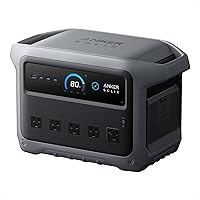
Anker SOLIX C1000 vs Bluetti Elite 100 V2: Which Is Better? (November 2026)
Pick the Bluetti Elite 100 V2 for most buyers: it weighs less, charges fast without an app, and its 1800W output comes with 3600W of surge. The Anker SOLIX C1000 is the better pick if solar charging is central to your plan.
On this page (7 sections)
Pick the Bluetti Elite 100 V2 for most buyers: it weighs less, charges fast without an app, and its 1800W output comes with 3600W of surge. The Anker SOLIX C1000 is the better pick if solar charging is central to your plan.
Both are 1kWh LiFePO4 power stations with 1800W rated AC output, so the choice comes down to small gaps. Weight, charging speed, UPS behavior and solar headroom separate them more than capacity does.
This anker solix c1000 vs bluetti elite 100 v2 comparison works from the published specs for both units. The Bluetti takes the overall win, and the Anker is the better pick for panel owners.


How do the capacities and outputs compare?
The Anker has a slightly larger battery, and both deliver the same 1800W rated AC output. That makes their real difference charging time and how much surge headroom each one gives.
The Bluetti Elite 100 V2 holds 1024Wh. The Anker SOLIX C1000 holds 1056Wh.
That 32Wh gap is about 3%, which is minutes of runtime on most loads, not hours.
Rated output is 1800W on both. Surge differs.
Bluetti lists 3600W of surge power and calls the feature Power Lifting, while Anker rates the C1000 for 2400W with SurgePad.
A higher surge rating helps when a motor starts. A fridge compressor or a circular saw can draw well above its running watts for a moment, so the Bluetti has more room before it shuts down.
The surge figure is the one to read when you compare motors, since the label names differ between the two units.
What can each one run?
The Bluetti station has 11 ports and Bluetti says it handles up to 90% of everyday appliances. Bluetti's own example runs a 50W fridge for about 14.3 hours on a charge, and it says the same battery charges a phone 52 times.
The Anker also has 11 ports and Anker says SurgePad lets it run 99% of appliances. These percentages are maker claims from different test conditions, so compare the wattage you need.
Anker's own runtime math is worth knowing. For heavy AC loads it suggests multiplying the 1056Wh capacity by 0.9 for inverter efficiency and dividing by the device's watts.
On a 50W fridge that works out to roughly 19 hours, though the compressor's surge draw will cut into it.
Add up the watts of everything you'll plug in at once. A 1kWh battery can't run a 1500W space heater for an hour, but it will keep a router, lamp, laptop and phone charged overnight.
Port count matters less than port mix. Both stations have enough outlets for a camping kitchen, but check that the ports you need, AC and USB, are the ones each unit provides before you commit.
Which one charges faster?
Both reach 80% in about 45 minutes, but the Bluetti needs less setup to do it. The Anker's fastest rate depends on the app and a warm room.
Bluetti's 1200W TurboBoost AC charging takes the Elite 100 V2 to 80% in roughly 45 minutes. A full charge takes about 70 minutes.
That's a plug-in-and-wait process with no mode to switch on.
Anker says the C1000 reaches 80% in 43 minutes in UltraFast mode. You turn UltraFast on in the Anker app, so a phone is required, and the estimate assumes no load and an ambient temperature of 68 to 122°F.
That temperature window is the catch for garage and shed users. Anker's own notes explain that the 43-minute figure assumes ideal conditions with no load and UltraFast on.
Below 68°F the station charges more slowly, which is common in an unheated garage in winter.
For camping and road trips, Bluetti offers a Charger 1 accessory for faster car charging, up to 6x faster according to Bluetti. If you do most of your charging from a vehicle, factor that in.
Which is better for solar charging?
The Anker is the better solar station, because its 600W panel input fully charges the battery in about 1.8 hours. The Bluetti takes up to 1000W of solar, but hitting that rate needs a large panel array.
Anker's 600W solar input charges the C1000 fully in about 1.8 hours at that rate. The station uses an 11 to 60V solar charger with an XT-60 connector, and Anker's PS100, PS200 and PS400 panels are the straight fit.
Bluetti rates the Elite 100 V2 for up to 1000W of solar charging, with 50 to 90 minutes to full at that input. Bluetti recommends two or four of its 200W panels, and third-party panels work if they total 12 to 60V VOC and stay at or under 1000W.
The 600W Anker rate is easier to reach with a normal portable panel setup. Most campers run 200 to 400W, which both stations accept.
What also tips solar buyers to Anker is the battery rating. Anker quotes 3,000 cycles to a 10-year lifespan.
Bluetti quotes over 4,000 cycles to 80%. Bluetti's cycle count is the higher figure, so weigh how often you expect to cycle the battery.
How the input rules differ in practice
The two stations take different solar voltages and currents, and that shapes which panels you can reuse.
Anker spells out two current bands for its 11 to 60V input. From 11 to 32V the C1000 accepts 10A max, and from 32 to 60V it accepts 12.5A max.
Bluetti keeps it simpler: any panel or panel set that lands between 12V and 60V VOC and stays at or under 1000W will work through a compatible solar connector.
Anker also settles a question Bluetti owners ask just as often. On the C1000 you cannot charge from AC and DC at the same time.
If both are connected, AC input takes priority. Plan one charging source at a time rather than doubling up.
A note on battery life
Both use LiFePO4 chemistry, which handles deep discharges better than older lithium types. Bluetti's 4,000-cycle figure to 80% is the longer rating between the two.
Treat those cycle numbers as maker ratings. Charge cycles, heat and how deeply you discharge the battery all affect how long either station lasts.
At one full cycle a day, the difference between 3,000 and 4,000 cycles is years of service. At a few cycles a month, both figures run past the point where most owners replace the unit.
Which is easier to carry and live with?
The Bluetti is lighter and has a built-in handle, so it moves between rooms and cars more easily. The Anker is a good stationary unit but a heavier lift.
The Elite 100 V2 weighs 25 lb and measures 12.6 x 8.5 x 9.8 inches. Bluetti calls the design 35% smaller and 30% lighter than comparable 1kWh stations, and a hidden handle lets you pick it up one-handed.
The C1000 weighs 27.6 lb and measures 14.8 x 8.07 x 11.02 inches. Anker says it's about 15% smaller than other 1kWh units, but it's still the heavier of the two here.
For a station that lives in a closet until a storm, weight barely matters. For one that rides in a car or gets carried to a tent, 2.6 lb and a good handle make a difference.
Footprint beside a seat or in a boot is the other part of portability. The Bluetti's 17L body is the easier fit, while the Anker is about two inches longer front to back.
Noise and placement
Bluetti's silent mode runs at 30dB, and Bluetti calls that 50% quieter than other 1kWh power stations. That suits a bedroom or tent where fan noise would keep you up.
Anker doesn't publish a noise figure for the C1000. Keep either unit upright and out of a sealed box, since both need airflow to shed heat while charging or under load.
Bluetti says the Elite 100 V2 must not be laid on its side, because doing so can damage internal parts. Plan a spot where it can stand upright in the car.
What comes in each box
The Bluetti box holds the Elite 100 V2, an AC charging cable, a grounding screw and the user manual. There is no car charging cable, so vehicle charging relies on the Charger 1 accessory or a separate lead.
The Anker box holds the C1000, an AC charging cable, a car charging cable and a user guide. If you plan to charge on the road, the Anker is ready out of the box and the Bluetti needs one more piece.
That single difference matters for road-trippers who want to top up from a 12V socket without buying anything else. It matters less for anyone who charges at home and hauls the station already full.
Which backup features matter for a power outage?
The Bluetti has the clearer UPS spec: a 10ms switchover keeps a router or PC running through an outage. Anker lists UPS support on the C1000 without giving a switchover time.
A 10ms changeover is fast enough for most electronics, so a desktop computer or Wi-Fi router stays on when grid power drops. Bluetti names those two devices as the intended use.
The Anker's UPS listing covers the same kind of loads. With a 10ms figure published, the Bluetti is the easier one to size for a work-from-home setup.
For outages, think in two layers. The UPS function protects a router or PC for minutes to hours.
The full 1kWh battery then keeps lights, phones and a small fridge going longer.
Neither unit is a whole-home solution. A 1kWh battery covers the essentials in a short outage and buys time to move food or charge phones.
It is not a substitute for a generator when an outage runs for days.
What about emergency readiness?
Neither station includes a remote or a transfer switch, so plan to plug devices in by hand. The Bluetti's app works over Wi-Fi and Bluetooth for remote monitoring and updates, and Anker's app does similar duty.
Bluetti's app supports remote monitoring, managing power consumption and over-the-air updates. Anker's app handles charge speed and real-time power statistics.
Both need a phone, but only Anker ties its fastest charge rate to the app.
On battery backup calculations, our guide to the Anker SOLIX S2000 shows how a larger station covers whole-home essentials if 1kWh feels tight.
Anker SOLIX C1000 vs Bluetti Elite 100 V2: which should you buy?
Buy the Bluetti Elite 100 V2 if you want one 1kWh station for home backup, camping and quiet overnight use. It's the lighter unit, it charges fast without an app, and its 10ms UPS and 3600W surge fit outage duty.
Buy the Anker SOLIX C1000 if solar charging is central to your plan. The 600W solar input and 3,000-cycle rating suit a panel setup that runs most days, and the car charging cable in the box helps on the road.
The 1056Wh battery in the Anker buys you a few extra minutes per charge. Those minutes rarely change a buying decision.
Weight and surge headroom show up every time you move or start the station.
For a full picture of the Bluetti unit, our Bluetti Elite 100 V2 review digs into its runtime and daily use.
Who should skip both?
If you need to run a well pump, a large fridge or several high-draw appliances at once, step up to a 2kWh station. A bigger battery carries more surge and runs longer before it needs a recharge.
Readers weighing other 1kWh stations can compare the field in our Jackery Explorer 1000 v2 vs Anker SOLIX C1000 Gen 2 breakdown. The EcoFlow vs Anker comparison covers another common pairing.
Verdict
The Bluetti Elite 100 V2 takes the win at 8.7. Pick it when you want a light, quiet, fast-charging station that handles a router, a PC and a small fridge through an outage.
The Anker SOLIX C1000 scores 7.9 and wins for anyone whose main charging source is solar. Its 600W panel input and 1056Wh battery reward a setup where the station sits by a window or on a roof circuit most days.
Match the choice to how you'll charge the station and how often you'll carry it. That pair of habits decides more than the capacity gap ever will.
Frequently asked questions
Is the Bluetti Elite 100 V2 really lighter than the Anker C1000?
Yes. The Bluetti weighs 25 lb and the Anker weighs 27.6 lb.
Bluetti also builds in a hidden handle so you can carry it one-handed, which matters when you move it between a closet, a car and a campsite.
Which power station charges faster from a wall outlet?
The Bluetti charges to 80% in roughly 45 minutes using 1200W TurboBoost AC charging. Anker says the C1000 reaches 80% in about 43 minutes in UltraFast mode, which requires the app and household temperatures between 68 and 122°F.
The two are close, and the Bluetti needs less setup.
Can the Anker C1000 run a fridge during an outage?
At 1056Wh it can run a small fridge for a while, though the compressor's startup draw matters. Anker rates the C1000 at 1800W with 2400W SurgePad output.
Check the fridge's running and surge watts against that before relying on it.
Which has the better battery lifespan?
Anker rates the SOLIX C1000 at 3,000 cycles over a 10-year lifespan, while Bluetti rates the Elite 100 V2 at over 4,000 cycles to 80%. Bluetti's figure is higher, and both use LiFePO4 cells that age slowly with normal use.