Best 500W Power Stations for Home and Camp: Top 7 Picks (October 2026)
The best 500W portable power stations for home and camp include the Bluetti Elite 30 V2 for compact backup, the Jackery Explorer 500 v2 for longer runtime, and the EcoFlow River 2 Max for quick top-ups.
On this page (9 sections)
- How did we choose these best 500W power stations?
- How do the best 500W power stations compare?
- Which 500W power station fits your home or camp plans?
- How do you choose the right 500W power station?
- Is 500W enough for home backup?
- Is a 500W power station useful for camping?
- How should you set up and care for a 500W power station?
- What mistakes should you avoid with a 500W power station?
- Which 500W power station should you choose?
The best 500W power station for most compact home backup and camp needs is the Bluetti Elite 30 V2, with 600W continuous output and a 10ms UPS. For more stored energy, choose the Jackery Explorer 500 v2; for one-hour AC charging, consider the EcoFlow River 2 Max.
These stations are useful for selected electronics, lights and small appliances, but they are not whole-home backup. Compare watts for power at a moment with watt-hours for energy stored before you decide.
Start by listing what you need to keep running and for how long. Our guide to what a 500W power station can run helps estimate the load, and our portable power station checklist covers the rest.
Our picks at a glance
-
1

-
2

-
3
How did we choose these best 500W power stations?
These picks balance capacity, output, charging and portability for home backup and camp use. We compared those features with UPS support, since a quick switch can matter for electronics that need uninterrupted power.
The score reflects how well each option fits this roundup's needs. A compact, lower-capacity unit can suit short backup tasks, while a larger battery can be more useful when recharging is limited.
The “500W” label does not mean every station here has the same output. The Bluetti and River 3 Plus provide 600W continuous output, the Jackery is rated at 500W, and the River 2 Max has 300W AC outlets.
How do the best 500W power stations compare?
The Jackery stores the most energy in this group, while the Bluetti combines a lighter carry with UPS support and higher continuous output. Compare capacity, output and weight together to find the right tradeoff.
| Product | Best for | Capacity | Continuous output | Weight | Our score |
|---|---|---|---|---|---|
| Bluetti Elite 30 V2 | compact backup | 288Wh | 600W | 9.5 lb | 8.9 |
| Jackery Explorer 500 v2 | longer runtime | 512Wh | 13.3 lb | 8.4 | |
| EcoFlow River 2 Max | quick top-ups | 499Wh | 13.3 lb | 8.3 | |
| EcoFlow River 3 Plus | desk backup | 286Wh | 10.4 lb | 8.2 | |
| EcoFlow River 3 Max | expandable storage | 572Wh | 8.4 kg | 8.0 | |
| VTOMAN Jump 600X | laptop charging | 268.8Wh | 600W | 9.9 lb | 7.4 |
| ENOFLO 600W Power Station | varied device ports | 296Wh | 600W | Not stated | 6.9 |
Which 500W power station fits your home or camp plans?
The right pick depends on your actual loads, how long you need power and whether you can recharge during use. The seven options below cover quick desk backup, camp electronics and larger portable batteries.
Bluetti Elite 30 V2: Best for compact backup
- 288Wh capacity
- 600W continuous output
- 1500W power lifting mode
- 10ms UPS
A compact station with 600W continuous output, a 1500W power lifting mode and a 10ms UPS. Its 288Wh capacity favors shorter backup tasks over long runtimes.
Pros
- 10ms UPS
- 380W AC charging
- 9.5 lb weight
Cons
- 288Wh capacity is modest for longer loads
- Power lifting mode is not the same as continuous 1500W output
The Bluetti Elite 30 V2 is the strongest fit for compact backup that may move between home and camp. Its 600W continuous output handles more than a 500W-rated unit, while the 288Wh battery is better suited to brief use than a long outage.
At 9.5 lb, it is the lightest pick here with a stated weight. Its 10ms UPS can help keep a laptop, router or CPAP powered through a sudden outage, but runtime still depends on the load.
Bluetti says AC charging can reach 80% in 45 minutes and a full charge in 70 minutes at up to 380W. It also supports solar, car and lead-acid battery charging.
The 1500W power lifting mode is not 1500W of continuous output. Skip this pick if your plan depends on running a high-wattage appliance continuously or if you need a larger energy reserve without frequent recharging.
Jackery Explorer 500 v2: Best for longer runtime
- 512Wh capacity
- 500W rated output
- 1000W surge
- 10ms UPS
The largest stated capacity here pairs with 500W rated output and a 1000W surge. It suits buyers who want more stored energy for low and moderate loads.
Pros
- 512Wh capacity
- 10ms UPS
- LiFePO4 battery rated for 6,000 charge cycles
Cons
- 13.3 lb weight
- Solar panels are sold separately
Choose the Jackery Explorer 500 v2 when stored energy matters more than the lightest carry. Its 512Wh battery is the largest in this roundup, with 500W rated output and a 1000W surge rating.
That capacity suits buyers planning longer use for phones, laptops, cameras and small appliances that stay within the output limit. It weighs 13.3 lb and has two pure sine wave AC outlets.
Jackery describes a 10ms UPS and bypass charging, with operation as low as 28 dB. Its LiFePO4 battery is rated for 6,000 charge cycles, and AC charging reaches 80% in 52 minutes.
Solar panels are sold separately. Skip it if you need the lightest unit for frequent carrying or want to start with solar charging without buying a separate panel.
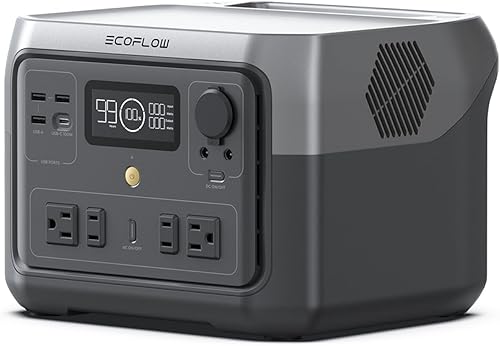
EcoFlow River 2 Max: Best for quick top-ups
- 499Wh capacity
- One-hour AC recharge
- 220W solar input
- 13.3 lb
A 499Wh battery and one-hour AC recharge make this a fit for buyers who can top up between uses. Its standard AC outlets are rated at 300W.
Pros
- One-hour AC recharge
- Solar input up to 220W
- 13.3 lb
Cons
- AC outlet rating is 300W
- EcoFlow recommends checking X-Boost with your device
The EcoFlow River 2 Max suits buyers who want a quick wall recharge between trips or backup periods. Its 499Wh capacity is close to the Jackery's, and EcoFlow says AC charging takes about one hour.
Pay attention to the AC outlet limit: the outlets are rated at 300W, even though EcoFlow describes output up to 1000W with X-Boost. Check the appliance's requirements and EcoFlow's guidance before relying on X-Boost.
It weighs 13.3 lb and accepts solar input up to 220W, with a stated recharge time as fast as 2.3 hours. EcoFlow also describes a 30ms switchover to battery power when grid power stops.
Choose it if quick recharging is a priority and your AC devices fit the outlet rating. Skip it if you need standard AC output above 300W or a stated UPS switch time under 10ms.
EcoFlow River 3 Plus: Best for desk backup

- 286Wh capacity
- 600W steady output
- 1200W with X-Boost
- Under-10ms UPS
Its under-10ms UPS and supported computer interface suit a home office that needs a quick power switch. The 286Wh capacity is better for brief backup than long outages.
Pros
- Under-10ms UPS
- Expandable to 858Wh with compatible batteries
- One-hour AC recharge
Cons
- 286Wh before expansion
- Compatible extra batteries add carry weight
The EcoFlow River 3 Plus is a sensible desk backup for electronics that need a quick switch during an outage. It provides 600W steady output, three UPS-supported AC outlets and an under-10ms UPS, but its 286Wh battery favors short backup periods.
EcoFlow describes a PC/NAS-compatible interface, software alerts and automatic data saving at low battery. Those features can suit a home office or gaming setup where an unexpected shutdown could interrupt work.
AC charging takes one hour. You can add a compatible EB300 or EB600 extra battery to reach up to 858Wh, though additional capacity also means more gear to carry.
Choose it for a compact UPS setup that may grow later. Skip it if you need a longer backup window straight away and do not want to add an extra battery.
EcoFlow River 3 Max: Best for expandable storage

- 572Wh capacity
- 600W output
- Under-10ms UPS
- Includes EB300 extra battery
The 572Wh configuration includes a River 3 Plus and EB300 extra battery. Its described features include 600W output and an under-10ms UPS.
Pros
- 572Wh total capacity
- EB300 included
- Under-10ms UPS
Cons
- 8.4 kg weight
- The described features are for the River 3 Plus configuration
The EcoFlow River 3 Max is the pick for buyers who want 572Wh included in an expandable River 3 setup. Its configuration contains a River 3 Plus and an EB300 extra battery, with described features including 600W output and an under-10ms UPS.
The added battery gives you more stored energy than the River 3 Plus alone. That can be useful for a home backup spot or vehicle trip where you want extra runtime without assembling the configuration yourself.
The stated weight is 8.4 kg, about 18.5 lb. That makes it a heavier carry than the 10.4 lb River 3 Plus, so it is less appealing for frequent walks between a car and campsite.
Choose it if you want more EcoFlow capacity included from the start. Skip it if easy carrying is more important than the added battery, or if the River 3 Plus's smaller capacity already covers your loads.
VTOMAN Jump 600X: Best for laptop charging

- 268.8Wh capacity
- 600W continuous output
- 100W USB-C PD
- 1200W peak
A 100W USB-C PD port can fast-charge compatible laptops, while its 9.9 lb weight helps with car-to-campsite trips. Its battery capacity is the smallest in this group.
Pros
- 100W USB-C PD port
- 600W continuous output
- Fast AC and DC charging
Cons
- 268.8Wh capacity
- Solar input is limited to 120W
The VTOMAN Jump 600X fits mobile work and camping where a compatible laptop can charge through USB-C. Its 100W USB-C PD port is the standout feature, and the station weighs 9.9 lb.
The 268.8Wh capacity is the smallest in this group, so plan for shorter sessions or frequent recharging. It also has a second 30W USB-C port, a 30W USB-A port, 600W continuous output and a 1200W peak.
VTOMAN says AC and DC simultaneous charging can reach 80% in 50 minutes and full charge in 75 minutes. Solar input is limited to 120W, and the panel is sold separately.
Choose it if laptop charging and a manageable carry matter more than long runtime. Skip it if you need the biggest battery here or want to recharge from a higher solar input.
ENOFLO 600W Power Station: Best for varied device ports

- 296Wh capacity
- 600W continuous output
- Nine ports
- Pass-through charging
This station provides 296Wh, 600W continuous output and a range of AC, USB and DC ports. ENOFLO says it supports pass-through charging.
Pros
- Nine ports
- Three-hour AC recharge
- Pass-through charging
Cons
- Solar panel is not included
- AC output draws power while it is on
The ENOFLO 600W Power Station is a basic choice for people who need several connector types in one unit. It has 296Wh of capacity, 600W continuous AC output and nine ports across AC, USB and DC.
ENOFLO says it supports pass-through charging and takes three hours to recharge from AC. It also supports car and solar charging, though the solar panel is not included.
Turn off the AC output when you do not need it, since it continues to draw power while on. The unit's weight is not stated, so it is harder to compare for trips where every pound matters.
Choose it if the port mix and basic backup features match your devices. Skip it if weight is a key buying factor, or if you want a documented fast recharge or a clear battery expansion option.
How do you choose the right 500W power station?
Choose by load, runtime and recharge plan, in that order. The station must supply enough power for your devices at the same time, store enough energy for the hours you need, and recharge in a way that suits your location.
First, check each device's running wattage and add the loads you expect to use together. Keep the total below the station's continuous output rating, and leave room for devices that start with a surge.
Next, estimate runtime from watt-hours. A simple starting point is battery capacity multiplied by an efficiency allowance, divided by the device's wattage; the result is only an estimate because inverter losses, idle draw and changing device use affect it.
For example, a 50W device uses about 50Wh per hour before conversion losses. A 288Wh battery will run it for less than 5.8 hours through AC, so plan for a shorter period.
Finally, compare charging inputs and portability. A fast wall recharge helps between uses, while solar can extend a trip if sunlight and panel input suit the station; it is not a guarantee of a full battery by a set time.
Is 500W enough for home backup?
A 500W-class station can cover selected electronics and small appliances, but it cannot run every household device at once. Choose the essentials first, then check their combined load and each device's startup demand.
A router, laptop, phone and a few lights may fit within the output limit. A kettle, toaster or space heater can use much of that limit on its own, and motor-driven devices may need extra power when starting.
UPS switching time matters for computers, routers and other electronics that can lose a connection or work during an outage. The Bluetti and River 3 Plus state switch times of 10ms or less, while the River 2 Max describes 30ms.
For a refrigerator, sump pump or other motor load, compare both startup and running watts with the station's limits. Our guide to running a sump pump from a portable power station walks through the checks.
Is a 500W power station useful for camping?
Yes, it can be useful for phones, lights, camera batteries and other small loads if the capacity matches the length of your trip. Decide whether you can recharge from a wall outlet, car or solar panel while away.
The lightest stated weights here range from 9.5 to 10.4 lb, while the Jackery and River 2 Max weigh 13.3 lb. A lighter station is easier to carry, but a larger battery may matter more if you will charge several devices over multiple days.
Solar input is a maximum, not a promise of a set recharge time. Sunlight, panel angle and weather affect the energy collected, so keep a backup charging plan.
If you want to pair a station with panels, see our guide to solar panels for portable power stations. For the difference between a battery station and a kit with panels, read portable power station vs solar generator.
How should you set up and care for a 500W power station?
Set up the station before an outage or trip, while you have time to check connections and controls. Charge it, read the model's instructions, and confirm that your devices draw less than its continuous limit.
Test your intended setup with the actual devices, especially if a motor or compressor needs a startup surge. For a UPS, connect the equipment you need to protect and confirm which outlets support UPS operation.
Keep vents clear and protect the unit from moisture. Turn off outputs you are not using, since an enabled AC inverter can draw power even when no device is connected.
Recharge before storage and check the unit periodically according to its instructions. For cold-weather use, follow the limits for your model and see our guide to using a portable power station in cold weather.
What mistakes should you avoid with a 500W power station?
The most common mistake is treating watts and watt-hours as the same number. Watts tell you whether the station can supply a device; watt-hours help estimate how long it can supply that device.
Do not rely on surge capacity as a continuous rating. A power lifting or X-Boost feature may help with some compatible loads, but it does not replace checking the device's normal draw and startup needs.
Avoid planning around a best-case runtime or solar recharge time. Leave reserve energy for conversion losses and changing conditions, and make sure you know what charging options are available where you will use the station.
Which 500W power station should you choose?
Choose the Bluetti Elite 30 V2 for compact backup, 600W continuous output and quick UPS switching. Choose the Jackery Explorer 500 v2 for the largest stated battery, or the EcoFlow River 2 Max if one-hour AC charging matters and your devices fit its 300W AC outlets.
Pick the River 3 Plus for a compact desk UPS that can expand later, or the River 3 Max for more EcoFlow capacity included. The VTOMAN Jump 600X suits compatible laptop charging on the go, while the ENOFLO makes sense when its port mix is the priority.
Before you buy the best 500W power station for your needs, write down the devices you will run, their startup and running watts, and the hours you need them powered. If the wattage exceeds the station's limit or the runtime estimate is too short, choose a larger class of power station.
Our top 3 picks at a glance
-
1
-
2
-
3
Frequently asked questions
What does 500W mean on a power station?
A 500W rating usually describes the power an inverter can provide at a time, while watt-hours describe stored energy. Check both figures: a station may run a device below its output limit but still run out of energy quickly.
Also compare a motor's startup demand with the station's surge limit.
Can a 500W power station run a refrigerator?
It depends on the refrigerator's running and startup wattage, plus how long you need it to run. Compare those demands with the station's continuous output and surge limit, then estimate runtime from its watt-hour capacity.
Our guide to what a 500W power station can run explains the calculation.
Is a 500W power station enough for camping?
It can suit camping if your devices stay within its output limit and the battery holds enough energy for your trip. Phones, lights and small electronics usually need less power than appliances that heat, cool or pump.
Add up your planned loads and decide how often you can recharge.
Can you use a portable power station indoors?
Follow your model's operating guidance when using a battery power station indoors. Keep ventilation openings clear, protect the unit from moisture, and follow the charging and operating instructions for your model.
See our guide to using a portable power station indoors.


