Anker SOLIX S2000 vs Bluetti Elite 200 V2: Which to Buy? (November 2026)
Pick the Anker SOLIX S2000 for fridge backup and light daily use, or the Bluetti Elite 200 V2 if you need 2,600W output for big appliances. The Anker SOLIX S2000 wins overall on runtime per watt-hour and weight, while the Bluetti wins on raw power and fast charging.
On this page (6 sections)
Pick the Anker SOLIX S2000 for fridge backup and light daily use, or the Bluetti Elite 200 V2 if you need 2,600W output for big appliances. For most households buying a first 2kWh station, the Anker SOLIX S2000 is the better buy: it's lighter, it ships with a surge-protector power strip and Anker claims about 20% longer runtime than typical 2kWh units.
The Bluetti Elite 200 V2 is the stronger machine on paper for raw output. It runs 2,600W continuously and pushes to 3,900W in power lifting mode, which puts it in a different class for hair dryers, coffee makers and microwaves.
This anker solix s2000 vs bluetti elite 200 v2 comparison sticks to the specs that decide real use: output, battery life, charging speed, weight and what's in the box. Then it names a winner for each kind of buyer.
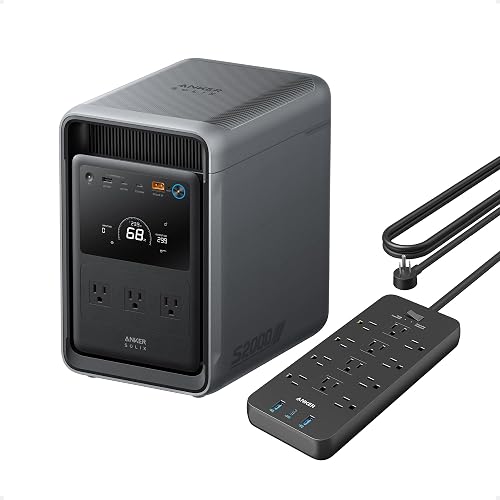

Anker SOLIX S2000 vs Bluetti Elite 200 V2: which wins overall?
The Anker SOLIX S2000 wins for most readers because it covers fridge backup at a lower weight and a longer claimed lifespan. The Bluetti wins only when your appliances demand more than 1,500W.
The S2000 carries a 2,010Wh LiFePO4 battery and a 1,500W continuous output with 3,000W peak. Anker says OptiSave tuning runs the unit 20% longer than other 2kWh systems, with a 35-hour fridge backup claim.
The bundled power strip adds 12 AC outlets, a 20W USB-C port, two USB-A ports and a 2,100J surge rating on a 5ft cord.
The Elite 200 V2 carries 2,073.6Wh of the same battery chemistry but a much higher 2,600W continuous output. Bluetti's HyperWatt tech also enables a 3,900W power lifting mode, and the unit takes up to 9 devices at once.
Capacity is nearly a wash, at about 2kWh each. The decision comes down to what you plug in, how you'll move the unit and how long you plan to keep it.
Battery life and cycle claims
Anker claims the longer cycle life; Bluetti claims the longer calendar lifespan. Anker rates its LFP cells at 10,000 cycles and a 15-year lifespan, calling them industrial-grade and double the life of standard LFP.
Bluetti rates its automotive-grade LiFePO4 cells at over 6,000 cycles and a 17-year lifespan, and says they passed 33 testing standards and earned CNAS certification.
Those claims describe different things. Ten thousand cycles is a deeper battery rating, but 17 years is a calendar figure from Bluetti, and both come from the brands.
Anker backs the S2000 with a 5-year warranty, so read the safety and warranty card that ships in the box.
If you plan to cycle the battery hard, the higher cycle count matters more. If the unit will sit mostly idle as outage insurance, calendar lifespan and standby efficiency matter more, and the Elite 200 V2 claims a 10W standby draw.
Bluetti also builds in multi-layer protection for extreme temperatures, which matters if the station lives in a garage or shed.
Output and what each can run
The Bluetti can run almost anything a household outlet can; the Anker is built for essentials. This is the clearest dividing line between the two.
At 1,500W continuous, the S2000 covers a fridge, lights, a router, fans, phones and a laptop without strain. Anker says the unit powers 99% of home essentials, and it warns that microwaves can pull more than their rated wattage.
A red overload indicator tells you to unplug the appliance right away when a load is too much.
The Elite 200 V2 at 2,600W continuous handles a hair dryer or a coffee maker alongside smaller loads. Its 3,900W lifting mode covers startup surges, so high-demand appliances don't trip the unit the way they can on a 1,500W station.
Bluetti lists four 2,600W AC outlets and up to 9 devices at once. Our Anker SOLIX S2000 review goes deeper on what the smaller output can and can't carry.
How long does each run a fridge?
Anker gives a 35-hour figure; Bluetti doesn't publish one, so run the math on your own fridge. Both stations hold about 2kWh, so the difference is efficiency, not capacity.
Anker's 35 hours comes from lab testing with a 700 L refrigerator at 77°F, with the main compartment at 37°F and the freezer at 0°F. The brand also shares a formula: capacity times 0.9 inverter efficiency, divided by daily energy use.
It recommends checking your fridge's Energy Guide label for rated daily consumption before trusting any runtime number.
The same math lands near 39 hours for a fridge that pulls 1.1kWh a day. Your fridge label holds the number you need, and your room temperature and how often you open the door will shift the result.
Anker also notes that actual runtime varies by fridge model, usage habits and ambient temperature.
For the Bluetti, the wider output headroom is the point, not longer fridge runtime. Bluetti instead cites a 120V 60W diesel heater running 10 hours a day for 3.3 days, which it calls 13% longer than similar stations.
That example shows how the 10W standby draw stretches light, steady loads. If fridge backup is your only goal, the Anker's efficiency claim makes it the more targeted pick.
If you also want to run a heater or power tools, the Bluetti's capacity goes further under heavy loads.
Which one charges faster?
The Bluetti charges faster from the wall; the Anker is easier to feed from solar. Bluetti's charging modes are the standout feature for anyone who wants to top up in a hurry.
The Elite 200 V2 offers Turbo, Standard and Silent modes through the Bluetti app. Turbo charges 0-80% in about 1 hour at 1,800W AC input, Standard fills the battery in 1.6 hours at up to 1,440W AC input, and Silent runs at 800W AC or solar to finish in about 3 hours at 16-30dB.
Bluetti also cites an AI-optimized BMS behind the charging control.
Dual AC and DC charging pushes the Elite 200 V2 from 0 to 80% in about 50 minutes. A full charge takes about 2.4 hours from 1,000W of solar panels, Bluetti says.
The station also accepts a 1200W alternator charger through BLUETTI Charger 2, which Bluetti says is 16 times faster than a standard car socket.
The Anker SOLIX S2000 takes up to 400W of solar input and supports six charging paths: AC, solar, AC plus solar, generator, alternator charger and car outlet. Solar at that input is modest, so the Bluetti is the faster solar platform if you own large panels.
The S2000's 400W ceiling means a full solar recharge takes longer, but AC plus solar at the same time speeds it up.
For an apartment renter topping up from a wall outlet, Bluetti's Turbo mode is a real convenience. For an off-grid setup running a small panel, both will work, and the S2000's lower solar ceiling matters less.
Note that the S2000 needs its app, connected over Wi-Fi, to change settings or install firmware updates.
Noise and standby draw
Anker recommends enabling Silent Mode in its app and capping charge power at 600W to quiet the fan. It also recommends keeping the S2000 on the latest firmware for best performance.
The Elite 200 V2's Silent Mode charges at 800W and runs at 16-30dB, which Bluetti describes as 45% quieter than typical 30-50dB stations.
Standby draw is where Bluetti is explicit. Its 10W figure is about three times lower than similar stations, the brand says, which means less wasted power on a long outage.
Anker's 6W idle draw claim on the S2000 is even lower on paper, though Anker frames it alongside its runtime advantage rather than as a separate efficiency headline. Neither figure replaces the other, so weigh them against how often the station sits plugged in and waiting.
Which one is easier to carry and set up?
The Anker is the easier unit to move and store. The Bluetti is about 18 lb heavier.
That gap matters if you'll carry the station up stairs or pack it for a trip.
The S2000 weighs 35.7 lb and measures 11.1 x 12.7 x 8.18 in. Anker says the all-in-one mainboard design makes it 30% smaller and 25% lighter than the average 2kWh station.
The numbers back that up: 2kWh in a body near 36 lb is compact for the class.
The Elite 200 V2 weighs 53.4 lb and measures 13.78 x 9.84 x 12.74 in. Bluetti says the cabinet is 40% more compact than earlier designs, but the weight is still a two-person lift for many people.
At 53.4 lb, it is closer to a small generator than to a carry-on.
Setup favors the S2000 for another reason: the power strip version ships with a 12-outlet surge protector that handles 2,100J and adds USB-A and USB-C ports. That gives you a whole desk or kitchen corner from one battery, with the station itself left in a corner.
Anker lists the strip in the box as "AS220+Power strip," so it arrives as a bundle.
If you want a quieter desk setup rather than a strip, the second S2000 variant has eight outlets split front and rear and under-10 ms UPS switchover. That makes it the better fit for a home office PC, which is why it earns the UPS badge here.
It ships with an AC cable instead of the strip.
Who should buy which?
Buy the Anker if your backup plan centers on a fridge and a few essentials. Buy the Bluetti if your loads are heavy or your charging time is short.
The Anker SOLIX S2000 suits renters and homeowners who want outage insurance without a heavy machine. Its 35-hour fridge claim, low weight and power strip make it a complete starter package.
Anker also positions the brand around plug-and-play solar storage for homeowners, RV owners and off-grid campers.
The Bluetti Elite 200 V2 suits people who already know they'll run high-draw appliances. A household that wants to keep the coffee maker and hair dryer going during an outage, or a camper who charges from a big solar array, gets more from the Bluetti's output and charging modes.
Bluetti lists camping, emergencies, home backup and RV use among its recommended uses.
Shop for a smaller first station and our Bluetti Elite 100 V2 review covers the lighter class. If the Anker brand itself is the draw, our EcoFlow vs Anker SOLIX comparison weighs it against a rival.
And if 1kWh units fit your budget better, our Anker SOLIX C1000 vs Bluetti Elite 100 V2 comparison covers that pairing.
Portability and travel use
For camping, tailgating and RV trips, the S2000's 35.7 lb weight is the difference between one trip to the car and two. It fits under a bench seat or in a truck bed box more easily than the Bluetti's larger cabinet.
Anker lists outdoor use and camping among the S2000's roles.
The Elite 200 V2 makes more sense for RV use, where weight matters less and the 2,600W output can run an RV microwave or induction burner. Its 10W standby draw also means less drain while parked.
Its 1200W alternator charging option fits the RV lifestyle too, since it tops up from the vehicle's own charging system.
Neither unit is small enough for backpacking. Both belong in the car-camping and roadside-emergency category, not the hiking pack.
Neither the S2000 nor the Elite 200 V2 includes solar panels in the box, so factor panels into your plan if off-grid charging matters.
Home backup and UPS use
For whole-home outage coverage, neither unit replaces a generator or a home battery. Both are portable stations that keep a few circuits alive.
The second Anker variant, sold with an AC cable rather than the power strip, adds sub-10 ms switchover and front-and-rear outlets. For a home office, that is the cleaner setup of the three products here.
Bluetti's Elite 200 V2 also offers ≤15 ms UPS backup, so both brands treat desk protection as a feature, though Anker's sub-10 ms figure is the tighter spec.
The Bluetti's 3,900W lifting mode gives it an edge if a sump pump or well pump is on your list. Check the startup wattage on any pump before relying on a 1,500W station.
For either brand, add up the wattage of what you need to run at the same time, then leave headroom.
Verdict: which should you buy?
Buy the Anker SOLIX S2000 for most households. Buy the Bluetti Elite 200 V2 only if you need more than 1,500W of output.
The S2000 takes the overall win on the specs that matter to a first-time buyer: lighter weight, a 10,000-cycle LFP rating from Anker, a 35-hour fridge claim and a bundled surge-protector strip. At 9.7, it carries the highest score of the group.
The Elite 200 V2 at 8.5 is the specialist. Its 2,600W continuous output and 3,900W lifting cover appliances no 2kWh Anker here can run, and its Turbo charging is quicker from the wall.
Its 6,000-cycle rating and 53.4 lb weight are the trade-offs you accept for that power.
If the S2000's second version suits your desk better, it scores 8.9 and shares the same battery and output. Pick it for the UPS switchover and cleaner outlet layout.
Between the two Anker versions, the strip bundle is the better starter kit and the cable version is the better home-office UPS.
Frequently asked questions
How long will each run a refrigerator?
Anker says the S2000 runs a 700 L fridge for up to 35 hours in lab conditions at 77°F. Bluetti doesn't publish a fridge runtime for the Elite 200 V2, so compare your fridge's daily kWh figure against each battery's capacity.
Can either power a microwave?
The Bluetti Elite 200 V2 is the safer choice for a microwave, since its 2,600W continuous output and 3,900W lifting mode cover startup surges. Anker warns the S2000 tops out at 1,500W continuous and that some microwaves draw more than their rated wattage.
Which is easier to carry?
The Anker SOLIX S2000. Both S2000 versions weigh 35.7 lb, and Anker says the all-in-one mainboard design makes it 30% smaller and 25% lighter than the average 2kWh station.
The Bluetti Elite 200 V2 weighs 53.4 lb, so plan on a cart or a second person for stairs.
Do both use LiFePO4 batteries?
Yes. Anker uses LFP cells rated for 10,000 cycles and a 15-year lifespan claim.
Bluetti's Elite 200 V2 uses automotive-grade LiFePO4 cells rated for over 6,000 cycles and a 17-year lifespan claim.
Cycle ratings and lifespan claims come from each brand.


