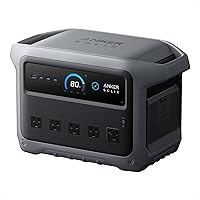
Bluetti Elite 30 V2 vs Allpowers R600: Which to Buy? (November 2026)
Pick the Bluetti Elite 30 V2 for most people, because it pairs a light 9.5 lb body with a 10ms UPS and 8 charging methods. The Bluetti Elite 30 V2 vs Allpowers R600 choice comes down to whether you need emergency switchover or a larger battery.
On this page (8 sections)
- Which power station wins on spec?
- Which one is better for storm and outage backup?
- Which is easier to carry and store?
- How do the batteries and lifespan compare?
- Which charges faster and from more sources?
- Who should buy the Bluetti Elite 30 V2?
- Who should buy the Allpowers R600 or a bigger Bluetti?
- Which should you buy?
Pick the Bluetti Elite 30 V2 for most people, because it pairs a light 9.5 lb body with a 10ms UPS and 8 charging methods. This Bluetti Elite 30 V2 vs Allpowers R600 comparison is really a question of size: the Elite 30 V2 is a carry-anywhere 288Wh station with fast switchover, while the R600 is built to hold more energy for longer outages.
The Elite 30 V2 suits blackout protection for routers, laptops and CPAP machines, and it's light enough to move around. The R600 has a place too, mostly for readers who want more stored power at home.
For the reasons below, the higher-scoring Bluetti is the one we'd pick for a first power station.
Which power station wins on spec?
The Bluetti Elite 30 V2 wins on useful specs for most buyers, with a 10ms UPS, 1500W lifting mode and a 288Wh LFP battery in a 9.5 lb frame. The Allpowers R600 counters with more capacity for the same shelf space.
Both are solar generators, so they work with panels for off-grid charging. The Bluetti's edge is in how it behaves when the grid fails.
| Product | Best for | Capacity | Output | Weight | Our score |
|---|---|---|---|---|---|
| Bluetti Elite 30 V2 | storm backup | 288Wh | 600W / 1500W lifting | 9.5 lb | 8.9 |
| Allpowers R600 | whole-home outages | 2073.6Wh | 2600W / 3900W lifting | 53.4 lb | 8.5 |
The table makes the trade clear: the Bluetti is the travel-first unit with fast backup switchover. The R600 is the home-first unit that trades portability for stored energy.
Where Bluetti Elite 30 V2 pulls ahead
The 288Wh LFP battery is small, yet the feature set around it is what sells the station. A 10ms UPS keeps a router or laptop alive through the brief drop that comes with a storm outage.
A 600W AC output doubles many small stations in its class. Turn on Power Lifting Mode and the peak rises to 1500W for a small kettle or toaster.
Charging is unusually flexible: 8 charging methods including AC, car, solar and a lead-acid battery. A 380W wall charge goes from 0 to 80% in 45 minutes and fully charges in 70 minutes.
It weighs 9.5 pounds and measures 9.8 x 7 x 6.6 inches. One person can lift it from a closet, pack it in a car trunk or carry it to a campsite.
Bluetti also backs it with a 60-month warranty. For a station this small, that's a long commitment from the brand.
Where the Allpowers R600 answers back
The R600's headline is capacity. It stores more watt-hours than the Elite 30 V2, which means longer runtimes on the same load or room for a bigger appliance.
If your main worry is keeping a fridge or a few lamps going through a longer outage, extra storage matters more than a lower weight. That's the case the R600 makes.
Before you settle on it, weigh how you'll move it and how you'll recharge it. A bigger battery takes longer to fill and is harder to carry.
You can also look at the Bluetti Elite 100 V2 if you want a middle size.
Which one is better for storm and outage backup?
The Bluetti Elite 30 V2 is the better storm backup, because its 10ms UPS and four UPS modes make it a set-and-forget unit for routers and medical gear. It's built to sit on a shelf plugged in until the power cuts.
Fast switchover is the point. A 10ms UPS is quick enough that a desktop, router or CPAP machine doesn't reboot during a short outage.
Bluetti names CPAP machines and laptops as the devices it's meant to protect.
The four UPS modes explained
The station has four UPS modes, and each one changes how it behaves when plugged into the wall.
Standard keeps the battery at 100% charge, so it's ready for backup the moment the grid drops. Time-of-Use suits areas with peak and off-peak rates, letting you store cheap power and draw on it when rates climb.
PV Priority works best in solar-rich homes, charging from panels first. Custom lets you mix and tailor modes to your needs.
You pick the behavior that fits your home. For a renter in a storm zone, Standard is the safe default.
Runtime for any device comes from a simple formula: 288Wh x 95% depth of discharge x 90% inverter efficiency, divided by the load plus idle draw. Bluetti lists self-consumption at 4.5W in AC-only use, 5W for DC-only and 9W when both run.
A 60W load lands around four hours, so plan around a small, critical set of devices.
If your outage plan is bigger than that, the next size up is a better fit. Our Bluetti Elite 100 V2 vs AC180 comparison covers that tier.
When the R600 is the safer buy for a long outage
Choose the R600's larger battery when your outages run long and you want to keep a fridge or a room of lights alive. More stored energy buys time, and time is what a multi-day storm takes.
Then weigh a bigger Bluetti against the R600. The Bluetti Elite 200 V2 holds 2073.6Wh and runs 2600W continuously.
That's a different class from both entry-level units, but it's the honest answer for whole-home backup.
Which is easier to carry and store?
The Bluetti Elite 30 V2 wins on portability, at 9.5 lb and roughly 9.8 x 7 x 6.6 in, small enough for a car trunk or a closet shelf. A larger battery like the R600 is a two-hand lift and a dedicated storage spot.
Weight shapes how often you actually use a power station. A light unit gets packed for the beach, a road trip or a tailgate.
A heavy one tends to stay where you put it.
The Elite 30 V2 is designed for exactly that carry-anywhere role. Bluetti calls it an entry-level station for camping, road trips, beach visits and home emergencies.
It has 9 outlets in total, so several small devices can share it without a power strip.
Compare that with the Bluetti Elite 200 V2, which weighs 53.4 pounds. It's still movable, but it's a station you place once and leave.
Bluetti describes it as 40% more compact than comparable units, which helps if the storage corner is tight, but the weight still decides who carries it.
That's the real choice in this matchup. Buy for the life you'll lead: if the station lives in a car, go light.
If it lives by the breaker panel, capacity beats weight.
How do the batteries and lifespan compare?
Bluetti's LFP battery and 6000-cycle claim on the Elite 200 V2 point to long life, and the Elite 30 V2 uses the same LFP chemistry in a smaller pack. LFP cells are the reason these stations last for years rather than months.
The Elite 30 V2 runs on a 288Wh LFP battery. Bluetti credits its UltraCell tech and smart cooling with cutting standby power consumption by half, which helps a small pack go further.
The Elite 200 V2 pushes that idea further. Bluetti says its LFP battery is automotive grade and rated for over 6000 cycles and a 17-year everyday lifespan.
The pack also passed 33 rigorous testing standards, and Bluetti claims multi-layer protection allows safe use in extreme temperatures. That's a durability claim, not a guarantee, but it tells you where the money goes.
Small packs and big packs both fade with use and heat. Keep either station out of a hot car in summer and avoid deep discharges when you can.
That simple care extends the cycle count you'll get.
If you want to compare brands on this point, our EcoFlow vs Bluetti post looks at how the two firms approach batteries and charging.
Which charges faster and from more sources?
The Bluetti Elite 30 V2 charges faster and from more sources for its size, with 8 charging methods and a 70-minute full wall charge. Wall time is the number most buyers care about during a storm season.
The 380W AC charge gets the Elite 30 V2 to 80% in 45 minutes. At the lower 200W setting, charging is gentler on the battery.
A car socket, a lead-acid battery, a generator and solar all work too. Bluetti even lists AC plus solar combined as a dual-input option rated up to 380W.
What the charging methods mean in practice
AC wall charging is the everyday route. The car socket covers road trips.
A lead-acid battery or generator covers off-grid or long-outage setups where a wall isn't handy. The Bluetti Charger 1 is another input Bluetti lists.
The station accepts solar through its included cable for Bluetti's 60W panel. For other panels, Bluetti sells a separate solar charging cable, and points to its 100W and 200W panels as matches.
The app adds Bluetooth and Wi-Fi control, so you can monitor a charge session without standing over the unit.
The R600 also takes solar, which is the point of a solar generator. If off-grid recharging matters most, look at charging input as closely as battery size.
A big battery with a weak solar input takes all day to fill.
Want more on pairing panels with a station? Our Jackery vs Bluetti comparison covers how each brand handles solar and charging.
Who should buy the Bluetti Elite 30 V2?
Buy the Bluetti Elite 30 V2 if you want a light, fast-charging station for storm backup, camping and small devices. It's the pick for someone who moves the station more than once a month.
It fits a router and laptop through a short outage, a CPAP machine overnight, and camp lights, speakers and a car fridge for a weekend. The 10ms UPS is the feature that makes it a real backup unit rather than a fancy battery.
The 9 outlets cover several small devices at once. The app adds Bluetooth and Wi-Fi monitoring, so you can watch the charge without crouching beside it.
It isn't the right pick if you plan to run a fridge or a heater for hours. For that load, step up in capacity.
Who should buy the Allpowers R600 or a bigger Bluetti?
Buy the Allpowers R600 if you want more stored energy in a home backup station and portability is secondary. The larger battery is the whole reason to choose it.
Then compare it against the Bluetti Elite 200 V2, which is the stronger home-backup option in this lineup. Its 2600W continuous output and 3900W lifting mode run a refrigerator, a hair dryer or a coffee maker.
Nine devices can run at once.
The Elite 200 V2 also charges fast: 0 to 80% in 50 minutes with dual AC and DC input, or 2.4 hours on 1000W of solar. Its Turbo, Standard and Silent modes let you trade speed for quiet, and Silent runs at 16-30dB, about 45% quieter than typical stations.
Bluetti also claims standby draw of just 10W, and gives an example of running a 120V 60W diesel heater for 3.3 days at 10 hours a day.
If you want a full review of the middle tier before deciding, our Bluetti Elite 100 V2 review walks through that model.
Which should you buy?
For most readers, buy the Bluetti Elite 30 V2. It wins this Bluetti Elite 30 V2 vs Allpowers R600 matchup on the things that matter day to day: a 9.5 lb body, a 10ms UPS, a 70-minute wall charge and 8 charging methods, all for less stored energy than the R600.
Choose the R600 only if you've decided that stored energy is your top priority and you'll keep the station at home. If that's your plan, the Bluetti Elite 200 V2 is the better big-battery pick in this family, with 2073.6Wh, 2600W output and that 6000-cycle LFP pack.
The rule is simple: buy for how you'll use the station. A light unit you carry every weekend beats a big one you never move.
Frequently asked questions
Can the Bluetti Elite 30 V2 run a CPAP machine?
Yes. Bluetti lists CPAP machines among the devices the 10ms UPS is built to protect, and 288Wh should carry a typical machine through a night.
Check your machine's watt draw to confirm the runtime.
How fast does the Elite 30 V2 recharge from a wall outlet?
Bluetti says a 380W wall charge takes the Elite 30 V2 from 0 to 80% in 45 minutes and to full in 70 minutes. Charging slows if you switch to the 200W setting.
What can the Elite 200 V2 power during an outage?
Its 2600W continuous output covers refrigerators, hair dryers and coffee makers, and Power Lifting raises the peak to 3900W. It also has a 15ms UPS so plugged-in gear keeps running when the grid drops.
Is the Elite 30 V2 light enough to hike with?
At 9.5 lb and about 9.8 x 7 x 6.6 in, it's a carry-in-camp station rather than a backpacking one. Treat it as car camping and emergency gear that one person can lift and move alone.
Can I add solar panels to the Elite 30 V2?
Yes. It accepts solar through the included cable for Bluetti's 60W panel, and other panels work with a separate solar charging cable.
Bluetti points to its 100W and 200W panels as matches.