Anker SOLIX C1000 Gen 2 vs EcoFlow Delta 3 Classic: Which Is Better? (November 2026)
The EcoFlow Delta 3 Classic is the better overall pick, while the Anker SOLIX C1000 Gen 2 wins for higher output, lighter carrying and faster solar charging. Choose between them by charging speed, portability and the appliances you need to run.
On this page (12 sections)
- Anker SOLIX C1000 Gen 2 vs EcoFlow Delta 3 Classic: which wins?
- How do their power and capacity compare?
- Which one charges faster from AC power?
- Which is better for solar charging?
- Which power station is easier to carry?
- Does outlet count change the decision?
- Which one suits UPS backup?
- What battery life and care differences matter?
- Who should buy the EcoFlow Delta 3 Classic?
- Who should buy the Anker SOLIX C1000 Gen 2?
- How should you make the final choice?
- Final verdict: which should you buy?
The EcoFlow Delta 3 Classic is the better overall pick, while the Anker SOLIX C1000 Gen 2 is the better choice for lighter carrying, higher continuous output and faster solar charging. This Anker SOLIX C1000 Gen 2 vs EcoFlow Delta 3 Classic comparison comes down to how you plan to move, charge and use the power station.
Both models store about 1kWh of energy. EcoFlow lists 1024Wh, while Anker lists 1,024Wh.
Their output, charging methods and portability differ enough to make one a better fit for your backup plan.
The EcoFlow Delta 3 Classic also has the higher score here at 8.9. The Anker SOLIX C1000 Gen 2 scores 8.8 because its 2,000W output, 10 ports and lighter 11.3 kg body are strong advantages for mobile use.

Anker SOLIX C1000 Gen 2 vs EcoFlow Delta 3 Classic: which wins?
EcoFlow wins overall for home backup because it combines 1024Wh capacity, 1,800W output, 3,600W surge power, fast AC charging and a sub-10ms UPS. Anker wins the specific jobs that favor a lighter unit, more continuous output or faster solar input.
The EcoFlow Delta 3 Classic is the safer general pick for a home emergency setup. Its 3,600W surge figure gives it the higher stated short startup allowance, while 1,800W continuous output covers refrigerators, microwaves, laptops and other listed use cases.
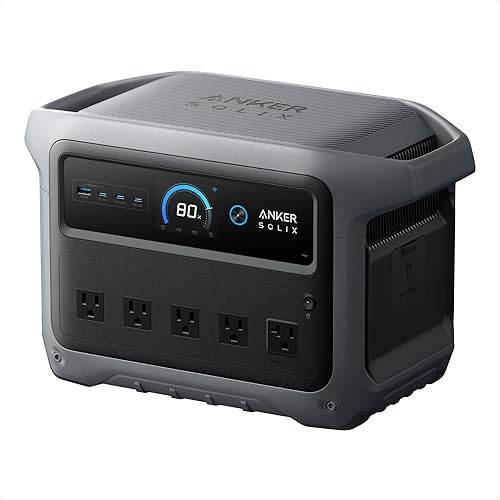
The Anker SOLIX C1000 Gen 2 delivers 2,000W continuous output and 3,000W peak power. That makes it the better match when the load stays within its higher running limit and you expect to carry the station between rooms, an RV or an outdoor location.
For more context on the EcoFlow model, our EcoFlow Delta 3 Classic review looks at the same station in a dedicated buying guide.
How do their power and capacity compare?
The 2 models hold almost the same amount of energy, but Anker provides 200W more continuous output and EcoFlow provides 600W more surge power. Capacity is close enough that output and charging needs should guide the decision.
EcoFlow's 1024Wh capacity and Anker's 1,024Wh capacity describe nearly the same stored-energy class. In daily use, both are aimed at portable backup, camping, remote work and selected household devices rather than unlimited whole-home power.
Anker's 2,000W output gives it the advantage for equipment that needs more running power. Its 3,000W peak figure still sits below EcoFlow's 3,600W surge figure, so a device's startup demand matters as much as its normal wattage.
EcoFlow uses 1,800W output with X-Boost technology. Its stated scenarios include refrigerators, microwaves and laptops, and X-Boost can expand use up to 2,600W for heavier loads.
Don't add the wattages together or treat either station as a permanent replacement for household electricity. Match the running and startup needs of each appliance to the station's stated output.
Which one charges faster from AC power?
EcoFlow reaches 80% in 45 minutes, so it has the quicker stated partial recharge. Anker fully recharges in 49 minutes at 1,600W with HyperFlash enabled, which favors getting the whole battery ready quickly.
The difference reflects 2 useful charging priorities. EcoFlow's 0–80% figure suits a short break between outages or a quick top-up before leaving home, while Anker's 49-minute full-charge figure suits a user who wants the complete 1,024Wh reserve ready soon.
Charging speed depends on the mode being used. Anker's HyperFlash feature is enabled in the Anker app, and its charging speed depends on battery temperature.
The stated UltraFast charging speed slows when the battery cell temperature is between 0 and 20 °C.
EcoFlow uses X-Stream AC charging for its 0–80% result. Both stations need a suitable power connection and enough ventilation around the unit during charging.
Pick EcoFlow for the shortest stated route to a high partial charge. Choose Anker if a fast full charge is more useful for your routine.
Which is better for solar charging?
Anker is the solar winner because its stated full recharge takes 1.8 hours with 600W of solar input. EcoFlow takes 2.5 hours with a 500W solar panel, so it needs more time under the stated conditions.
Anker's solar input supports up to 600W and 60V maximum. That gives off-grid users a higher stated input ceiling, provided the solar setup matches the station's limits.
EcoFlow's solar result uses a 500W panel, described as optional. Its 2.5-hour recharge time still gives a clear path to renewable charging for camping, off-grid use and backup planning.
Solar charging changes with sunlight, panel position and conditions. The published times are useful comparisons, not a guarantee that every day will produce the same result.
The choice is direct: choose Anker when solar recovery time is a main concern. Choose EcoFlow if a 500W solar setup fits your existing plan and you prefer its broader home-backup package.
Which power station is easier to carry?
Anker is easier to move because it weighs 11.3 kg and is designed around a compact, portable body. EcoFlow weighs 26.7 pounds, so it remains portable but asks more from anyone carrying it over stairs, gravel or longer distances.
Anker measures 15.1 in long, 8.2 in wide and 9.6 in high. The product data describes it as 14% smaller and 11% lighter than similar models, with use in rooms, RVs, beaches and parks.
EcoFlow measures 7.9 x 11.1 x 15.7 in and weighs 26.7 pounds. Its shape is still suitable for camping, commercial and residential use, but its weight makes placement more important.
A power station that stays beside a refrigerator can be heavier without causing daily trouble. One that travels to a campsite or moves between a living room and office benefits more from Anker's lower weight.
Our comparison of the Jackery Explorer 1000 v2 vs Anker SOLIX C1000 Gen 2 adds another portable-power option if carrying weight is central to your choice.
Does outlet count change the decision?
Anker wins on stated port count with 10 ports, while EcoFlow provides 6 outlets. The difference matters when several low-power devices need charging at the same time.
The Anker SOLIX C1000 Gen 2 is built around 10 ports and a 2,000W output. That layout suits a remote work setup with several devices, a small collection of camping electronics or a household backup plan that avoids constant swapping.
EcoFlow has 6 outlets and 1,800W output. Six outlets can still cover a focused emergency load, especially when the goal is to keep one refrigerator, a laptop or selected electronics running.
Port count does not increase battery capacity. Ten connected devices still share 1,024Wh, and their combined running wattage must stay within the station's output.
Use a short list of the devices you would connect during an outage. If the list regularly reaches more than 6 powered items, Anker's port count gives it the clearer advantage.
Which one suits UPS backup?
Both are suitable for fast UPS backup, with under-10ms or 10ms switching stated for sensitive equipment. EcoFlow has the more specific under-10ms wording, while Anker states a 10ms UPS switchover.
EcoFlow names PCs, servers and medical devices among its UPS use cases. Its automatic switch to battery in under 10ms is designed to prevent interruptions, data loss or downtime during a power change.
Anker's 10ms UPS backup suits laptops and CPAP machines. The feature fits a work setup or essential nighttime equipment that needs a quick transition when the main supply drops.
A UPS function does not make either station a substitute for medical advice or an all-purpose backup system. Use the equipment's normal power requirements when deciding what to connect.
EcoFlow gets the edge for the more detailed stated UPS range and under-10ms figure. Anker remains a strong choice when UPS backup is needed alongside higher output and lower carrying weight.
What battery life and care differences matter?
Both use long-life battery technology, but their published durability details use different measures. EcoFlow lists LiFePO4 cells rated for 10+ years of daily use, while Anker states at least 80% capacity after 4,000 cycles.
EcoFlow combines LiFePO4 battery cells with EV-grade CTC design and a smart Battery Management System. Its stated 10+ years of daily use gives a simple time-based way to think about long-term backup planning.
Anker calls its durability system InfiniPower and states that the battery retains at least 80% capacity after 4,000 cycles. That cycle figure helps readers who expect frequent charging and discharging for RV or off-grid use.
The measures are not identical, so they should not be treated as a direct laboratory comparison. In either case, use the station within its charging limits and keep the unit in a suitable storage location.
Keep cables organized, avoid blocking airflow and use the app settings that match your routine. Anker offers Standard and Time-of-Use modes, while EcoFlow's app includes usage monitoring, charging schedules, Storm Alert and Self-Powered Mode.
Who should buy the EcoFlow Delta 3 Classic?
Buy the EcoFlow Delta 3 Classic for home backup, fast partial AC charging and the higher surge figure. It is the better fit for someone who wants one station to cover a broad mix of household and work devices.
The 3,600W surge rating gives EcoFlow more stated startup headroom than Anker's 3,000W peak. Its 1,800W continuous output remains below Anker's 2,000W, so the best match depends on the load's normal and starting demands.
EcoFlow also suits a solar plan built around 500W input, with a stated 2.5-hour recharge. Its 6 outlets are enough for a focused backup setup, and the 5-year manufacturer warranty adds a defined coverage period to the purchase decision.
The main trade-off is carrying weight. At 26.7 pounds, EcoFlow is heavier than Anker, and its battery cannot use the Delta 2 Smart Extra Battery or Delta 3 Series Smart Extra Battery.
Who should buy the Anker SOLIX C1000 Gen 2?
Buy the Anker SOLIX C1000 Gen 2 for camping, RV use, faster solar charging and a lighter carry. Its 2,000W output and 10 ports make it the more practical mobile station when several devices share a compact setup.
Anker's 1,024Wh capacity matches EcoFlow's stated 1024Wh class. The 600W solar input and 1.8-hour full recharge give Anker the stronger solar result, while the 49-minute full AC recharge is useful when the battery needs to be ready quickly.
The 11.3 kg weight and 15.1 x 8.2 x 9.6 in dimensions suit room-to-room movement and outdoor trips. Its material data includes metals for the frame, housing and plastics for the outer casing and internal components, with a LiFePO4 battery.
The main trade-off is the missing capacity expansion feature. If your plan needs more stored energy later, the fixed 1,024Wh capacity matters more than the smaller body.
How should you make the final choice?
Pick EcoFlow when home backup and surge power come first; pick Anker when portability, outlet count and solar speed matter more. The overall winner remains the EcoFlow Delta 3 Classic because its higher score reflects the wider home-backup package.
Choose EcoFlow for a refrigerator, microwave, laptop and other selected household loads, especially when a 3,600W surge figure and under-10ms UPS are useful. Its 45-minute 0–80% AC result also makes a quick partial recharge simple.
Choose Anker for an RV, campsite, remote work setup or room-to-room backup plan. Its 2,000W continuous output, 10 ports, 600W solar input and 11.3 kg weight are specific advantages that EcoFlow does not match together.
Our broader EcoFlow vs Anker comparison can help if you are choosing between the brands beyond these 2 models. For another Anker size decision, see Anker SOLIX S2000 vs C1000 Gen 2.
Final verdict: which should you buy?
The EcoFlow Delta 3 Classic is the overall pick for most backup buyers, scoring 8.9 against Anker's 8.8. It combines nearly the same 1kWh capacity with 1,800W output, 3,600W surge power, fast AC charging, solar charging and a detailed UPS feature set.
The Anker SOLIX C1000 Gen 2 is the better targeted choice for people who carry their power station often. Its 2,000W output, 10 ports, 600W solar input and 11.3 kg weight make it the more mobile option.
In the Anker SOLIX C1000 Gen 2 vs EcoFlow Delta 3 Classic decision, start with the load and location. Buy EcoFlow for broader home backup and surge headroom, or buy Anker for a lighter station that charges faster from solar and handles a higher continuous load.
Frequently asked questions
Which power station charges faster from a wall outlet?
The EcoFlow Delta 3 Classic reaches 0–80% in 45 minutes with X-Stream AC charging. The Anker SOLIX C1000 Gen 2 fully recharges in 49 minutes at 1,600W with HyperFlash charging enabled.
Can the Anker SOLIX C1000 Gen 2 use an extra battery?
The Anker SOLIX C1000 Gen 2 has no capacity expansion feature. Its 1,024Wh battery is designed around portability, so choose a larger power station if your backup plan needs more stored energy.
Which has the faster solar recharge?
The Anker SOLIX C1000 Gen 2 fully recharges in 1.8 hours with 600W of solar input. The EcoFlow Delta 3 Classic recharges in 2.5 hours with a 500W solar panel, making Anker the faster solar choice from these stated figures.
Are both power stations suitable for UPS backup?
Yes. Both have a 10ms UPS feature for equipment such as laptops, PCs and CPAP machines.
The EcoFlow Delta 3 Classic switches automatically in under 10ms, while the Anker SOLIX C1000 Gen 2 provides UPS backup with a 10ms switchover.