Anker SOLIX S2000 vs Bluetti Elite 300: Which to Buy? (November 2026)
Pick the Bluetti Elite 300 for more capacity and 2,400W output, or the Anker SOLIX S2000 for a lighter unit you can carry more easily. The Bluetti wins for whole-home backup and RV use, while the Anker suits lighter backup and camping trips.
On this page (5 sections)
Pick the Bluetti Elite 300 for more capacity and 2,400W output, or the Anker SOLIX S2000 for a lighter unit you can carry more easily. In this Anker SOLIX S2000 vs Bluetti Elite 300 comparison, the Bluetti wins for home backup and RV power, while the Anker suits lighter backup and camping trips.
The Bluetti carries 3014Wh and a 2,400W inverter, with a TT-30 RV port and a 12V/30A DC output. The Anker offers 2010Wh and 1,500W in a 35.7 lb frame that's easier to move and store.
Both are LFP stations with fast UPS switching. The choice comes down to whether you need more stored energy or less weight to carry.
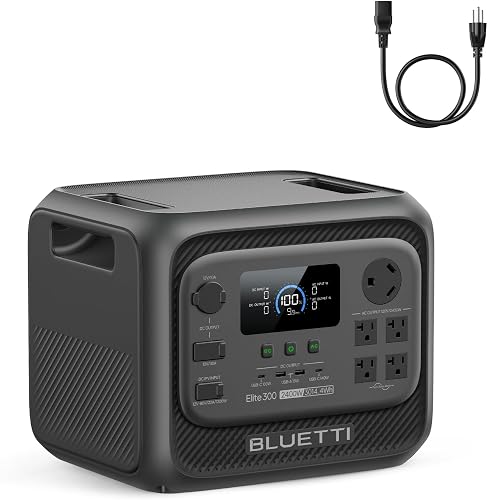 Best for home backup and RV power
BLUETTI Elite 300 Portable Power Station

Anker SOLIX S2000 vs Bluetti Elite 300: which has the power you need?
The Bluetti Elite 300 wins on raw power, with about 50% more capacity and 900W more continuous output. That gap decides the choice for anyone backing up a fridge, freezer or home office for hours.
The Bluetti holds 3014Wh and runs 2400W continuous with a 4800W surge. The Anker holds 2010Wh and runs 1500W continuous with a 3000W peak.
In practice, the Bluetti's bigger battery and stronger inverter let it run more appliances at once and for longer. Its 4800W surge also starts high-demand devices like kettles more easily.
The Anker's 1,500W output covers most everyday essentials. Anker says it powers 99% of home essentials, though a microwave or other high-draw appliance can pull more than its rated wattage.
The S2000 shows a red OVERLOAD indicator when an appliance draws too much, and Anker's own guidance says to disconnect that appliance right away to clear the fault. That tells you where the ceiling sits before you buy.
For a fridge backup, the Anker's 2kWh battery runs a fridge for up to 35 hours in lab testing at 77°F. Anker bases that figure on a 700 L refrigerator held at 37°F in the main compartment and 0°F in the freezer.
Your own runtime will vary with the fridge model, how often the door opens and the room temperature. The Bluetti's 3kWh capacity simply gives you more headroom for longer outages and more devices.
The Bluetti's output also covers the appliances people actually run during an outage. BLUETTI names refrigerators, lights, routers, TVs and CPAP machines for continuous load.
A CPAP machine matters for anyone who needs it overnight, and the Bluetti's capacity leaves room to run one through a full night and still keep the fridge cold. The Anker can handle a CPAP too, but its 2kWh battery runs out sooner when the fridge is sharing the load.
What each battery chemistry means over time
Both use LFP cells, but the Anker's cycle rating is higher. LFP batteries handle regular charging well, and the cycle counts are where the two stations split.
The Anker S2000 lists a 10,000-cycle LFP battery and a 15-year lifespan. It uses 314Ah LFP cells.
The Bluetti Elite 300 lists 6000+ cycles for its LiFePO4 battery.
The Anker's higher cycle count matters if you cycle the station daily. The Bluetti's 6000 cycles still cover years of typical backup use, since most home backup stations cycle far less often than a daily camping station.
The cycle counts are worth thinking about alongside capacity. If you plan to use a station as a daily solar buffer, the Anker's longer cycle rating softens the blow of its smaller battery.
If you need the extra 1kWh for emergencies, the Bluetti's 6000 cycles are still far beyond what most households will use in a decade.
How fast each one recharges
The Bluetti charges to 80% in 78 minutes, which is quick for a 3kWh battery. That speed matters when a storm warning gives you an hour to top up before the grid goes down.
The Anker's listed dual input option, AC plus solar at the same time, is the way to shorten a charge session.
The Anker also accepts up to 400W of solar, so a solar top-up during the day is practical for camping.
The Bluetti's recharge speed pairs well with its capacity. In a little over an hour you can push a 3kWh battery to 80%, which is a useful buffer before an outage.
The Anker's smaller battery needs less energy to top up.
Which is easier to move and store?
The Anker SOLIX S2000 wins on portability by a wide margin. At 35.7 lb, it's 22.3 lb lighter than the 58 lb Bluetti.
The Anker measures 8.2 x 11.1 x 12.7 inches and is described as 30% smaller and 25% lighter than the industry average for 2kWh stations. The Bluetti measures 14.4 x 12 x 11.7 inches.
The Bluetti is called the world's smallest 3kWh portable power station, verified by Frost & Sullivan. It's 59% smaller than traditional large power stations of the same class.
That's impressive for its capacity, but it's still a heavier unit to lift.
If you carry the station up stairs, load it into a car or move it between rooms often, the Anker's weight advantage is the deciding factor. For a station that stays in one spot, the Bluetti's extra weight buys you more capacity.
Fitting each station into a small space
The Anker's compact frame slides onto a shelf or into a closet more easily. Its 8 AC outlets sit front and rear, so you can plug always-on appliances in back and everyday devices up front.
That layout keeps cables out of the way in a small apartment or a van.
The Bluetti's larger cabinet needs more room, but its ports suit a garage or RV bay. Its box includes the station, an AC charging cable, a grounding screw and a user manual.
The grounding screw matters for RV and off-grid setups where you want a proper earth connection. Check the space you have before ordering either one.
The difference in footprint is easy to underestimate. The Anker stands about a foot tall and barely wider than a shoebox.
The Bluetti needs roughly 14 inches of width and 12 inches of depth, so plan a shelf or floor corner with room for its cables to breathe.
Which is better for RV and off-grid use?
The Bluetti Elite 300 is the clear RV pick. It has a TT-30 RV port and a 12V/30A DC output for 12V fridges, water pumps and diesel heaters.
That means RV owners can plug in camper appliances without adapters. The station is designed for camper vans, road trips and off-grid living.
The 12V/30A DC output is the part that separates it from most 2kWh stations, since many of them only offer AC outlets and USB ports. A 12V fridge that runs all night is one of the biggest power draws in a camper van, and this port feeds it directly.
The Anker S2000 has no 12V DC port and relies on its AC outlets. It still works for camping, but you'd need separate adapters for 12V gear.
Anker lists camping among its recommended uses, so it's a fine tent or tailgate station. It just isn't built around camper wiring.
For solar charging, the Bluetti accepts up to 1,200W with a 12V to 60V input range and a 22A current limit. It works with 1 to 2 BLUETTI 200W panels.
The Anker takes up to 400W of solar. The Bluetti's larger solar ceiling matches its bigger battery and suits longer off-grid stays.
A 3kWh battery needs more solar to refill, and the Bluetti allows three times the panel input of the Anker.
Charging options for each station
The Anker lists 6 ways to recharge: AC, solar, AC plus solar, a generator, an alternator charger or a car outlet. The Bluetti lists solar, AC, car, lead-acid and generator power.
The Bluetti's lead-acid option means you can charge it from a vehicle's starter battery or a separate lead-acid bank, which helps in a van or cabin build.
Both offer pass-through charging. The Bluetti explicitly supports charging while powering devices, and the Anker's dual input lets you combine AC and solar.
Pass-through matters when a station sits in a home office all day. It can stay plugged in and keep the router alive without you unplugging anything.
For an RV owner, the Bluetti's input range is the more flexible one. A 12V to 60V window accepts small panels and larger arrays alike.
The Anker's 400W ceiling keeps solar light, which suits a tent camper but not a rig that runs appliances through a cloudy week.
Which handles a power outage better?
The Bluetti Elite 300 wins for longer outages, while the Anker S2000 is the better fit for short ones. Both switch to battery automatically.
The Bluetti lists a 10ms UPS switch for computers, routers and home office gear. The Anker lists under 10ms switchover and a UPS mode for home office setups.
Both are fast enough to keep a desktop running. The Anker's dual-sided outlets let you keep always-on appliances plugged in at the rear and everyday devices at the front, so the UPS load stays separate from the phone chargers.
The difference is runtime. The Bluetti's 3014Wh runs a fridge, lights and router for longer than the Anker's 2010Wh.
A strong 4800W surge also lets the Bluetti start a kettle or other high-draw device without tripping.
The Anker's app adds a Silent Mode that reduces fan noise by capping charging at 600W or below. That helps if the station sits in a bedroom or office.
Anker also recommends keeping the firmware updated, since updates can fix bugs and add features. The Bluetti app offers remote on/off, custom charge settings and scheduling.
App features and smart control
The Anker requires its app for Wi-Fi features like Time-of-Use mode, Storm Guard and remote control. Without the app, you can't change settings or update firmware.
If you only connect over Bluetooth instead of Wi-Fi, Anker says several features are unavailable, including Time-of-Use mode, remote control, Storm Guard, custom mode, self-consumption mode and historical data. You also need to register and log in to enable the Wi-Fi connection.
That's more setup than some people expect.
The Bluetti app connects over Bluetooth or Wi-Fi and offers remote on/off, custom charge and discharge settings, and scheduling. Neither app is a reason to pick one over the other; the capacity and weight gap is bigger.
But if you want deep smart control, check how much the Anker asks of you first.
Which should you buy?
Buy the Bluetti Elite 300 if you want the most backup power for an RV or a whole room during outages. Its 3014Wh battery, 2400W output and TT-30 port make it the stronger all-round station for home and off-grid use.
The 4800W surge and 12V/30A DC port are features the Anker simply doesn't match.
Buy the Anker SOLIX S2000 if weight and size matter more than capacity. At 35.7 lb and 8.2 x 11.1 x 12.7 inches, it's easier to carry, store and move between rooms.
Its 10,000-cycle battery also suits daily cycling.
For a closer look at the Anker unit on its own, our Anker SOLIX S2000 review covers its runtime, app and charging in detail. If you're also weighing brands, our EcoFlow vs Anker comparison puts the two lineups side by side.
If you want a smaller Bluetti for lighter trips, the Bluetti Elite 100 V2 is a lighter option in the same family. And if you're comparing other Bluetti sizes, our Anker SOLIX S2000 vs Bluetti Elite 200 V2 breakdown covers that matchup.
The decision rule is simple. Choose the Bluetti for capacity and RV ports; choose the Anker for a lighter station that's easier to live with day to day.
Frequently asked questions
Is the Anker SOLIX S2000 or Bluetti Elite 300 better for home backup?
The Bluetti Elite 300 is the better home backup pick for most people. Its 3014Wh battery and 2400W output run more appliances for longer, and its 10ms UPS keeps computers and routers online.
The Anker S2000 covers lighter outages but has less capacity.
How much heavier is the Bluetti Elite 300 than the Anker S2000?
The Bluetti Elite 300 weighs 58 pounds, while the Anker SOLIX S2000 weighs 35.7 pounds. That 22.3-pound gap matters if you carry the station up stairs or load it into a vehicle often.
The Anker's smaller frame also stores more easily.
Which power station runs an RV better?
The Bluetti Elite 300 is built for RVs, with a TT-30 port and a 12V/30A DC output for fridges, water pumps and diesel heaters. The Anker S2000 has no 12V DC port and relies on its 8 AC outlets for RV gear.
Can both power stations charge from solar panels?
Yes. The Bluetti Elite 300 accepts up to 1,200W of solar with a 12V to 60V input range.
The Anker S2000 takes up to 400W of solar input.
The Bluetti's larger solar ceiling matches its bigger battery better for off-grid use.
Which one is quieter or easier to live with indoors?
The Anker S2000 has an app with a Silent Mode that reduces fan noise by capping charging power at 600W or below. The Bluetti Elite 300 app offers remote control and custom charge settings.
Both connect over Bluetooth or Wi-Fi for monitoring.
Do both have a UPS mode for computers?
Yes, both switch to battery backup automatically. The Bluetti Elite 300 lists a 10ms UPS switch, and the Anker S2000 lists under 10ms switchover.
Either keeps a desktop, router or home office running through a short outage.


